01Executive Summary
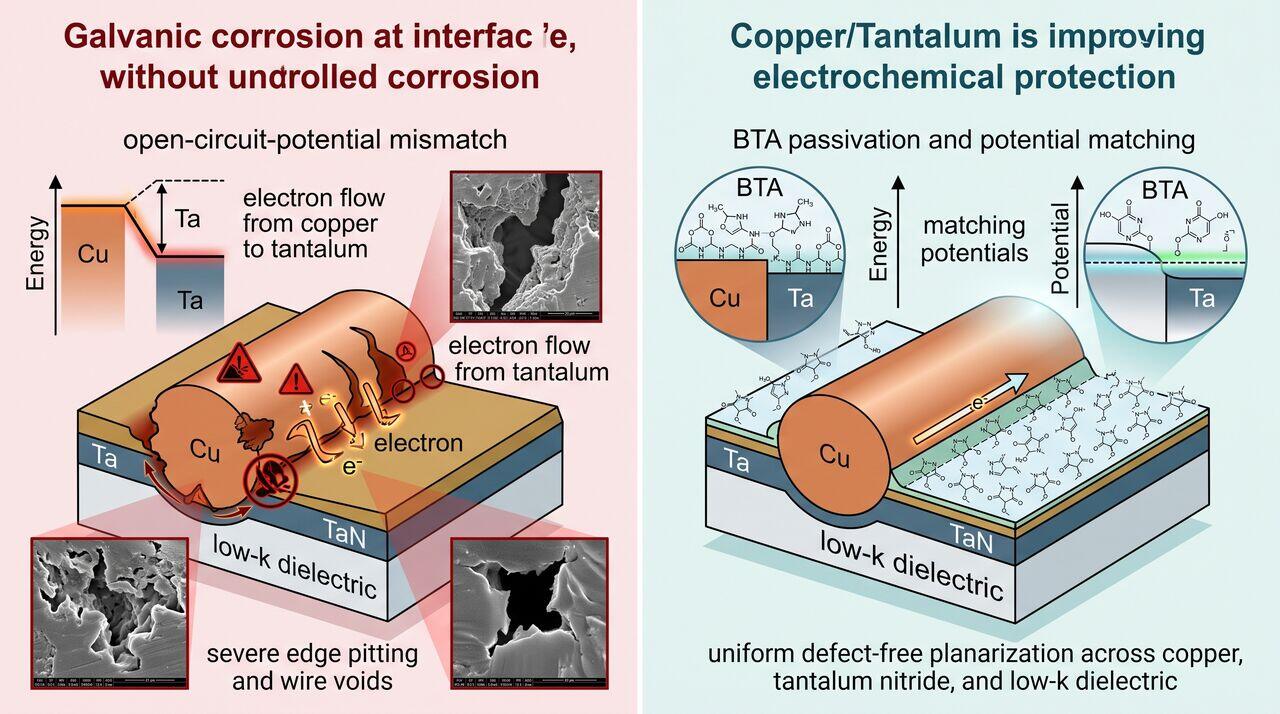
In copper Damascene CMP, bringing two dissimilar metals, metallic copper () and tantalum/tantalum nitride (), into simultaneous contact with an aqueous chemical slurry creates an active galvanic cell. Without precise electrochemical tuning, copper acts as an anode and suffers severe galvanic corrosion, resulting in deep copper voiding, wire pitting, and interconnect failure. This comprehensive guide details the electrochemical formulations of bulk and barrier CMP slurries, Pourbaix phase stability dynamics, Benzotriazole (BTA) passivation layer kinetics, and galvanic potential matching.
02Electrochemical Foundations of Copper CMP Slurries
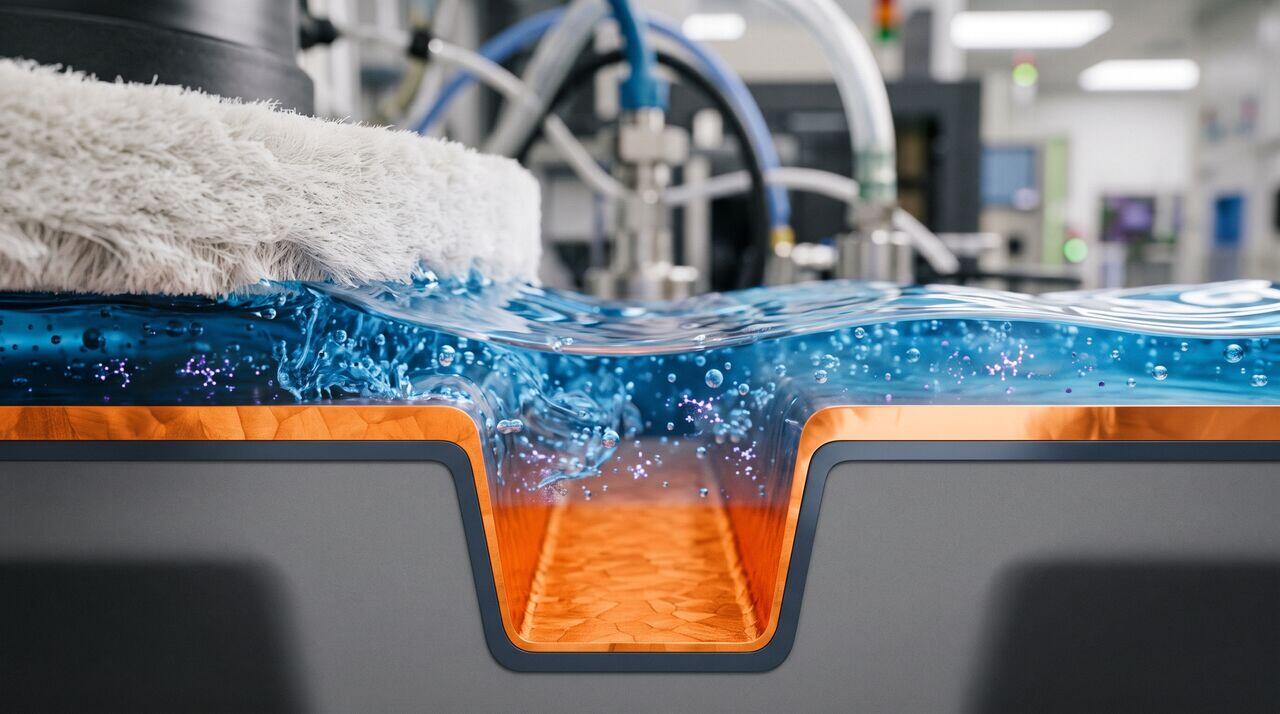
Copper CMP relies on a dynamic balance between chemical oxidation, surface dissolution, passivation, and mechanical abrasion. The slurry contains four essential chemical components:
- Oxidizing Agent (Hydrogen Peroxide, ): Oxidizes elemental copper () into cuprous () and cupric () ions:
- Complexing Agent (Glycine / Amino Acids): Chelate dissolved ions to form soluble, stable coordination complexes, preventing hydroxide precipitation:
- Corrosion Inhibitor (Benzotriazole, BTA, ): Forms a protective, insoluble polymeric film () over copper surfaces in low-shear recessed areas.
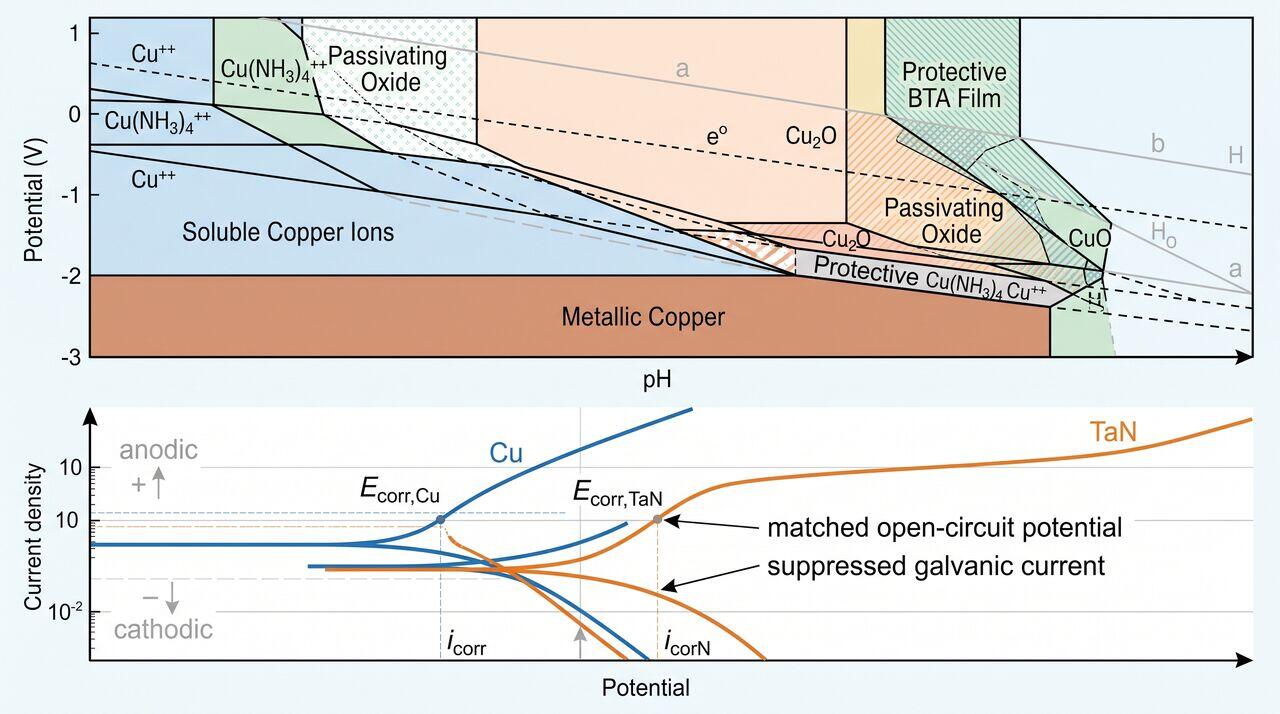
- pH Buffers: Maintain slurry pH within a tight window (typically pH for Step 1 or pH for Step 2) to stabilize oxidation states according to the Pourbaix Diagram.
03Galvanic Corrosion Mechanics at the Cu/Ta Interface
During Step 2 Barrier CMP, copper and tantalum nitride are simultaneously exposed to slurry electrolyte. Due to differences in their standard reduction potentials ():
Tantalum is chemically more noble/passivated in alkaline media due to a dense native oxide (), shifting the galvanic cell potential such that copper becomes the sacrificial anode:
This galvanic current drives accelerated copper dissolution specifically at the perimeter junction between the copper wire and the liner, producing severe galvanic pitting and edge voids.
04Mitigation Strategies: Potential Matching & Passivation
To eliminate galvanic corrosion during barrier CMP, slurry formulations deploy three electrochemical control strategies:
3.1 Open Circuit Potential (OCP) Matching
Chemical additives (corrosion inhibitors, oxidizers, and pH regulators) are tuned to shift the Open Circuit Potential (OCP) of copper () and tantalum () until their potential difference is minimized:
When , the driving force for galvanic electron transfer vanishes, suppressing localized corrosion currents.
3.2 Dynamic BTA Film Shear Removal
In recessed feature areas (low mechanical shear), the insoluble film remains intact, suppressing dissolution. At elevated topography peaks (high mechanical shear), pad asperities mechanically strip away the thin BTA film, allowing oxidation and removal to proceed exclusively at high points.
05Slurry Chemistry Formulation Matrix
| Component | Step 1 Bulk Cu Slurry | Step 2 Barrier Slurry |
|---|---|---|
| Target pH | (Acidic) | (Alkaline) |
| Oxidizer | ||
| Complexing Agent | Glycine () | Citric acid / EDTA |
| Corrosion Inhibitor | BTA () | Substituted Triazoles / BTA derivatives |
| Abrasive Type | Low-concentration Silica () | High-purity Colloidal Silica () |
| Selectivity Ratio |
→Prerequisites & continue reading
Prerequisites: ["p03-t3.2-t1-copper-damascene-barrier-cmp-fundamentals"]
Also in Topic 3.2, Copper Damascene & Barrier CMP:
Tier 1 · Copper Damascene & Barrier CMP Fundamentals: Multi-S…Tier 3 · Dishing & Erosion Tribochemical Models: Sub-10nm Int…