01Classical DLVO Theory of Colloidal Stability
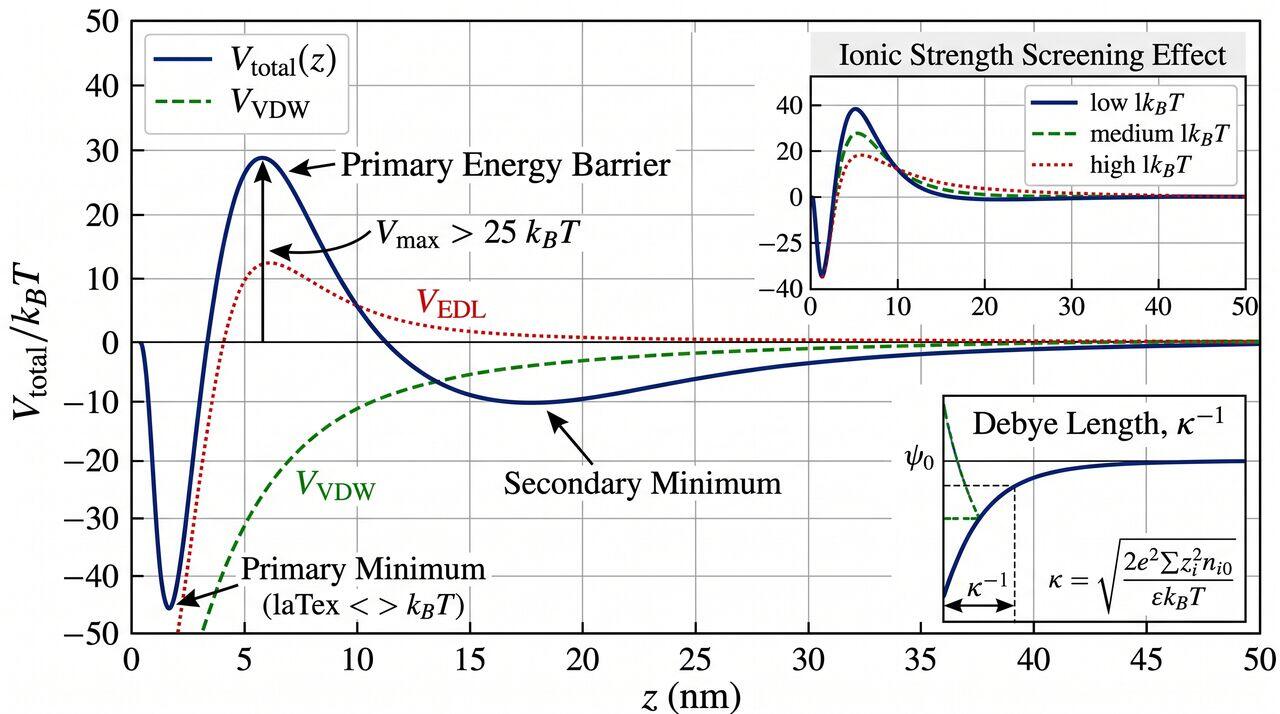
The balance between particle adhesion and removal in liquid media is quantitatively governed by DLVO Theory (Derjaguin, Landau, Verwey, and Overbeek). Total interaction potential energy between a particle and a flat surface is the sum of attractive van der Waals potential () and electrostatic double-layer repulsive potential ():
Mathematical Formulations
- van der Waals Potential (Sphere-Plate Geometry):
Where is the composite Hamaker constant, is particle radius, and z is separation distance.
- Electrostatic Double-Layer Potential (Linearized PB Approximation):
Where and are particle and wafer Zeta potentials, and is the Debye screening length:
To prevent particle re-deposition, the Primary Energy Barrier must exceed . This is achieved by increasing Zeta potentials () and reducing ionic strength I (dilute chemistries).
02Megasonic Acoustic Cavitation & Micro-Streaming Physics
Megasonic energy induces two distinct physical phenomena in liquid media:
A. Acoustic Micro-Streaming (Schlichting Boundary Layer Streaming)
Attenuated sound waves drive momentum into the liquid, generating localized boundary layer micro-vortices. The acoustic streaming velocity near the wall is given by:
Where is sound absorption coefficient, is acoustic energy density, and is angular frequency. This fluid drag exerts a net mechanical moment that rolls particles out of the primary energy well.
B. Stable Cavitation vs. Transient Bubble Collapse
The threshold pressure for acoustic cavitation is governed by the Blake Threshold :
At megasonic frequencies (), the acoustic period () is shorter than the time required for transient bubble growth. Bubbles oscillate stably around their equilibrium radius , generating gentle pressure waves () that detach particles without exceeding the yield strength of silicon nanosheets.
03Supercritical CO2 () Drying Physics
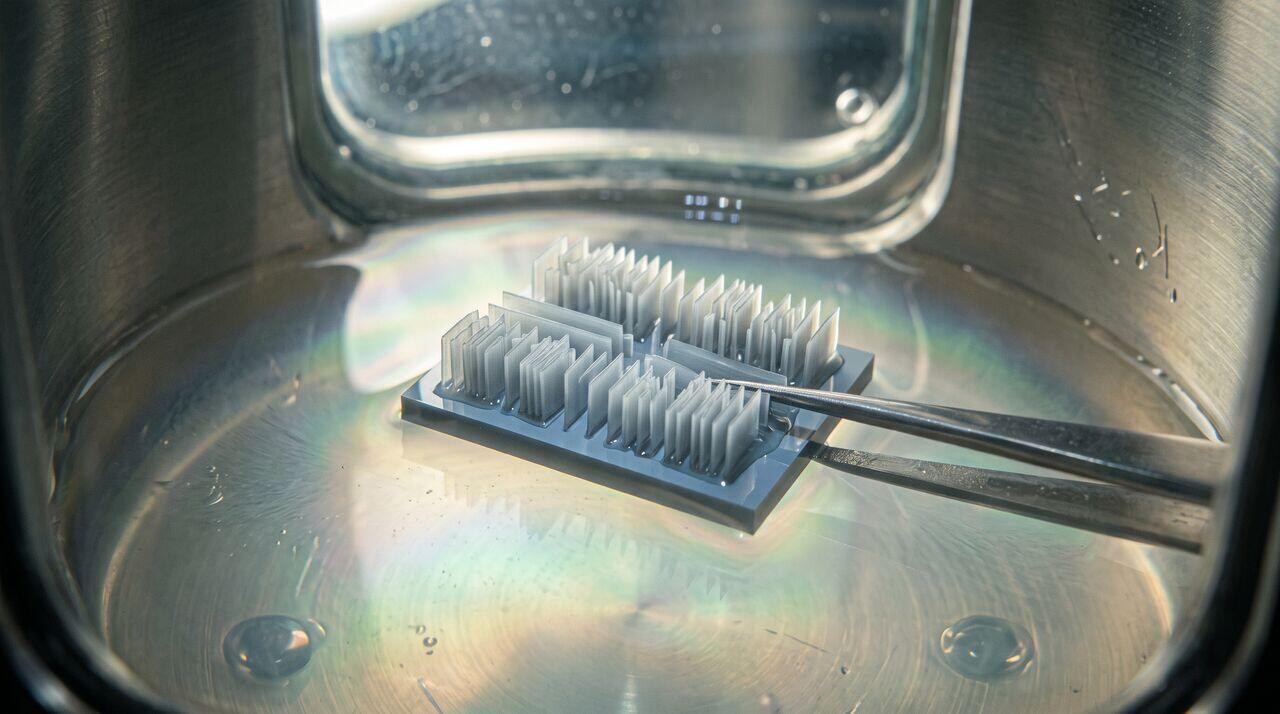
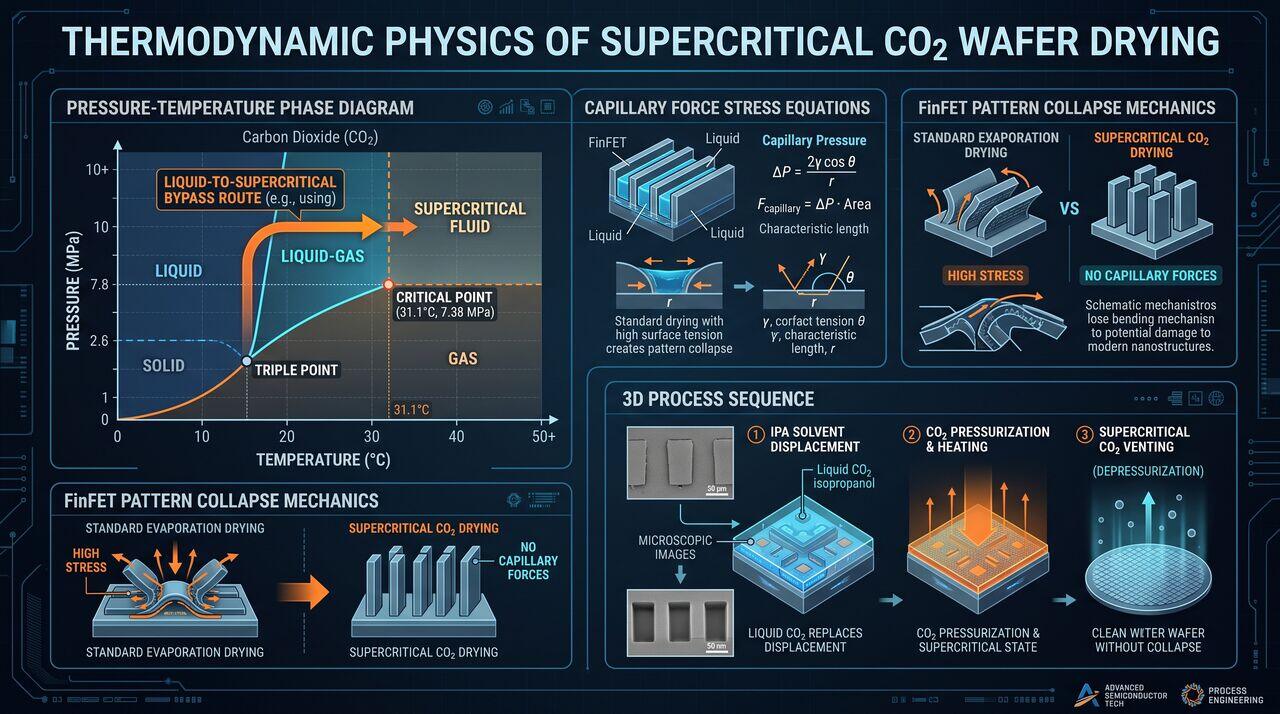
As transistor features scale to sub-2nm Gate-All-Around (GAA) nanosheets and high-aspect-ratio (> 100:1) 3D NAND memory structures, even Marangoni drying causes Pattern Collapse due to capillary forces during liquid withdrawal:
Where is liquid surface tension, is contact angle, and d is trench spacing.
The Supercritical Phase
Supercritical carbon dioxide () operates beyond its thermodynamic critical point ():
- Zero Surface Tension (): Capillary force drops precisely to zero ().
- Gas-Like Diffusivity & Liquid-Like Density: penetrates features effortlessly, dissolving organic solvents (IPA) and completely evacuating high-aspect-ratio trenches with zero structural damage.
→Prerequisites & continue reading
Prerequisites: Colloid & Surface Chemistry, Acoustics, Thermodynamics
Also in Topic 4.3, Particle Removal & Zeta Potential Engineering:
Tier 1 · Particle Removal Physics & Zeta Potential Manipulati…Tier 2 · Megasonic Transducer Kinematics & Marangoni Drying M…