01Executive Summary
Maintaining sub-1.5% wafer thickness non-uniformity across thousands of polishing cycles requires precise regulation of pad surface roughness and real-time endpoint clearing signals. This technical monograph details the mechanical kinematics of diamond conditioner disk wear, the physics of pad cut rate (PCR) control, and advanced multi-wavelength optical and eddy-current in-situ metrology architectures.
02Kinematics of Diamond Disk Pad Conditioning
Pad conditioning can operate in ex-situ mode (between wafer polishes) or in-situ mode (simultaneous with wafer polishing). In high-volume manufacturing, in-situ conditioning is standard to eliminate drift.
Pad Cut Rate (PCR) Formulation
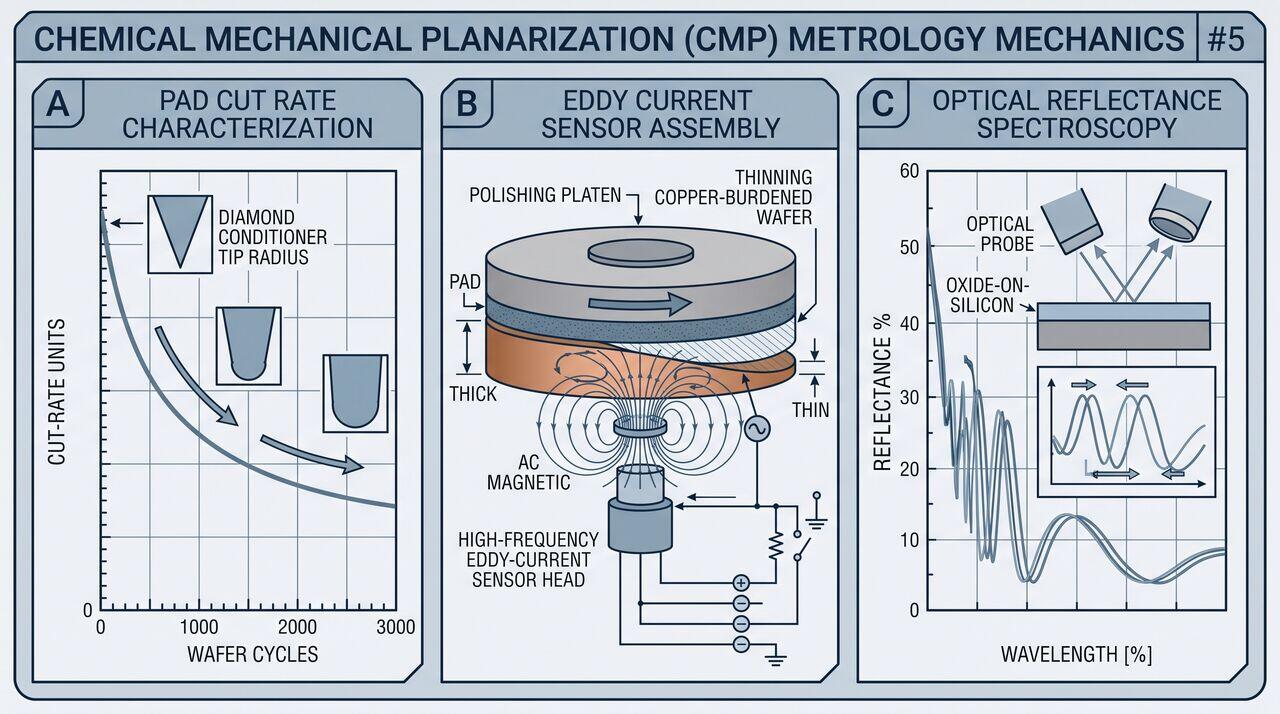
The rate at which polyurethane material is removed by the conditioner disk, the Pad Cut Rate (PCR), typically , is modeled by an extension of Preston's equation:
Where:
- is the applied conditioner down-force ().
- is the conditioner rotational speed ().
- is the radial velocity profile of the conditioning arm sweeping between the platen center and edge.
- is the conditioning wear factor, which decays over time as diamond tips dull.
03Diamond Disk Degradation Mechanisms
Diamond conditioner disks fail via two primary wear mechanisms, altering pad roughness over time:
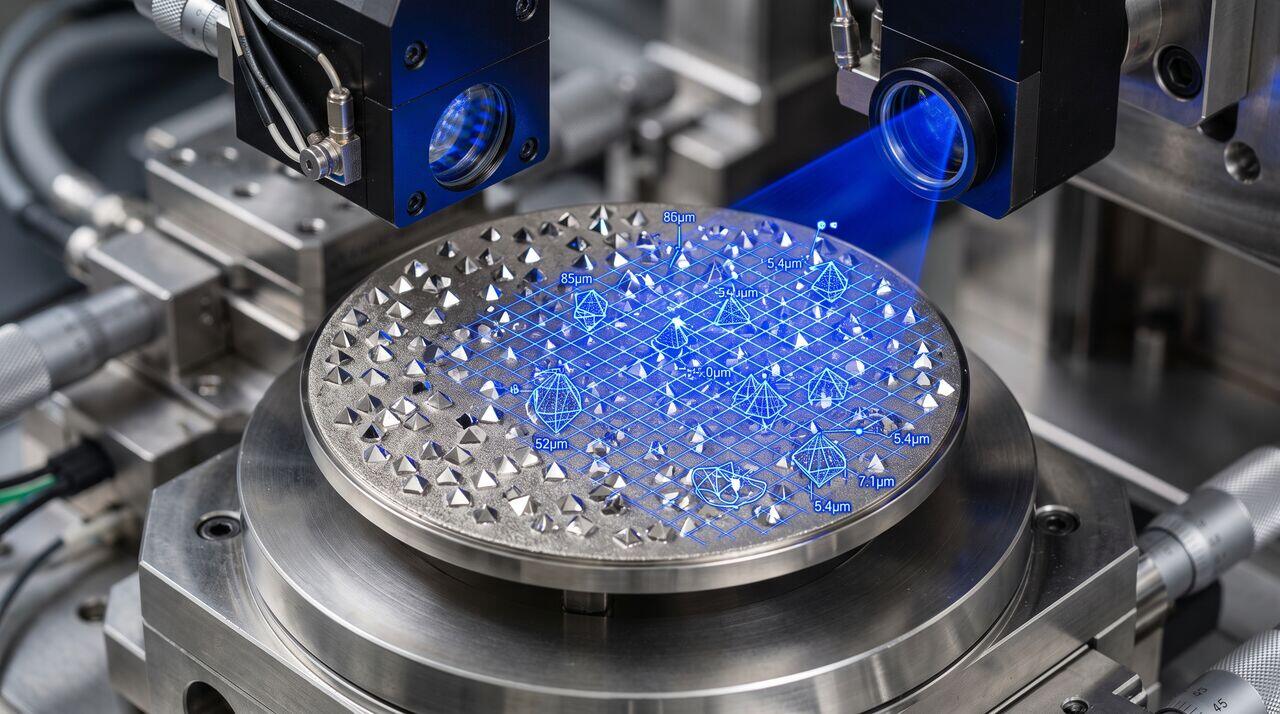
- Diamond Tip Attrition (Dulling): Micro-scale friction rounds sharp diamond crystal vertices, increasing tip contact radius (). According to indentation mechanics, dull tips push into polyurethane without cutting micro-grooves, dropping the PCR even though applied down-force remains constant.
- Diamond Pull-Out (Substrate Debonding): Cyclic shear fatigue causes the nickel electroplated binder matrix to crack, releasing entire diamond grit particles () into the slurry stream. Free diamond particles become catastrophic "killer" abrasive contaminants that induce deep micro-scratches across polished wafers.
04Advanced In-Situ Endpoint Metrology Architectures
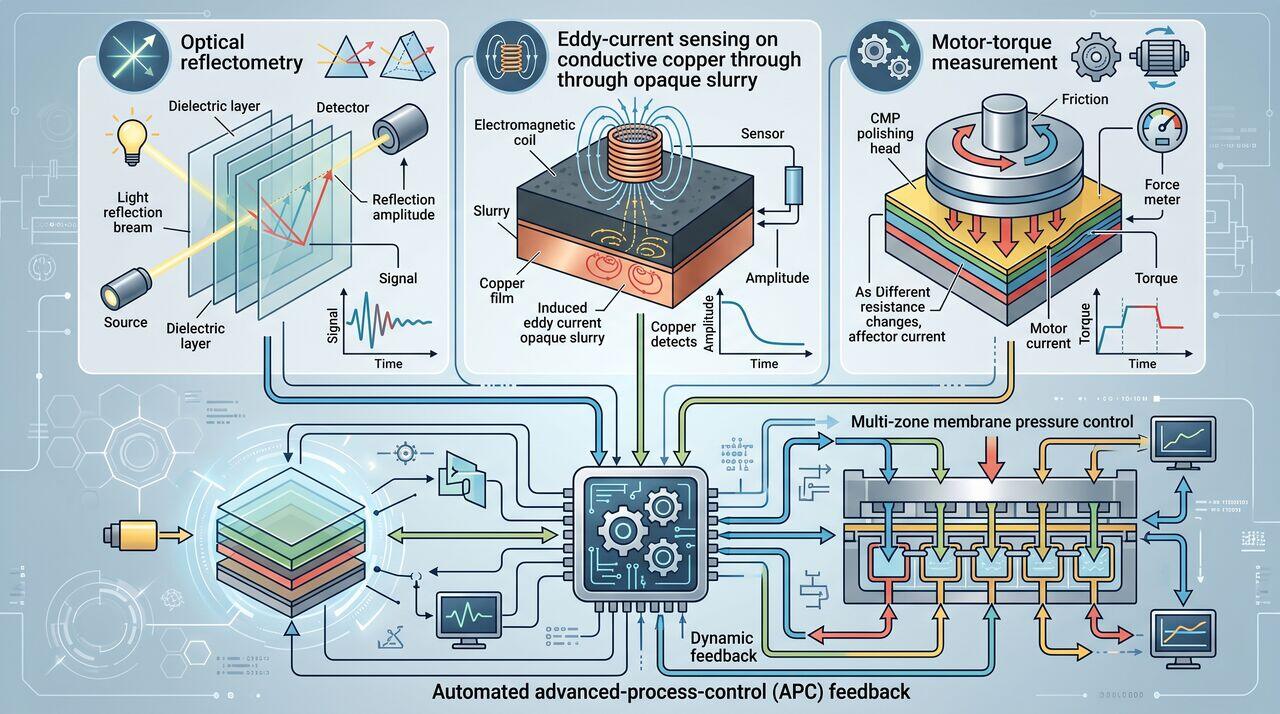
To terminate polishing with sub-nanometer accuracy, advanced CMP platforms combine multiple complementary metrology sensors:
3.1 Spectrophotometric Multi-Wavelength Optical EPD
Instead of single-wavelength lasers, modern optical EPD uses broadband xenon flash lamps (). Reflectance spectra are captured every platen rotation () and fitted against real-time Maxwell electromagnetic wave models:
This allows absolute film thickness (d) extraction in real time with precision.
3.2 High-Frequency Eddy-Current EPD for Metal CMP
For opaque conductive copper films, optical light cannot penetrate. Eddy-Current EPD embeds an AC magnetic coil inside the platen. The coil induces circular eddy currents inside the copper film proportional to its thickness:
As copper thins from , the induced magnetic back-EMF decays linearly, providing continuous thickness tracking through opaque slurries without physical contact.
→Prerequisites & continue reading
Prerequisites: ["p03-t3.3-t1-slurry-pad-conditioning-metrology-fundamentals"]
Also in Topic 3.3, Slurry, Pad Conditioning & CMP Metrology:
Tier 1 · Slurry, Pad Conditioning & CMP Metrology Fundamental…Tier 3 · Colloidal Slurry Stability & Pad Asperity Kinetics: …