01Executive Summary
In Chemical Mechanical Polishing (CMP), the polishing pad and chemical slurry are dynamic consumables that degrade continuously during tool operation. As polyurethane pads polish wafers, their surface micro-pores become compressed and clogged with polishing debris, a phenomenon known as pad glazing, causing material removal rates to decay rapidly. To maintain stable wafer-to-wafer performance, CMP tools rely on in-situ pad conditioning using diamond-grit disks alongside advanced optical and motor-current endpoint detection metrology. This fundamental guide explores pad surface dynamics, diamond disk mechanics, and real-time process monitoring.
02The Pad Glazing Problem & Pad Conditioning Solution
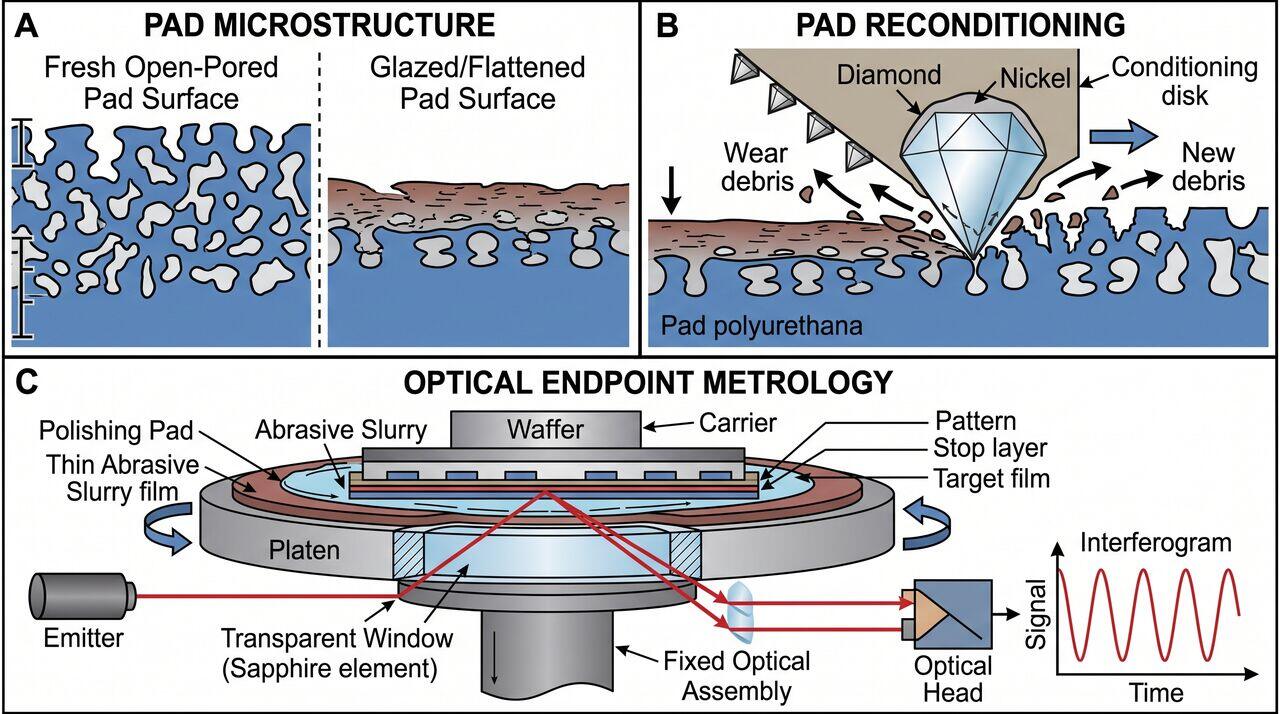
Polyurethane polishing pads contain millions of microscopic closed-cell pores ( diameter) designed to absorb chemical slurry, trap abrasive nanoparticles, and deliver them to the wafer interface.
During polishing, intense mechanical friction and down-force cause two failure modes:
- Plastic Deformation (Asperity Flattening): Pad asperities deform plastically under shear heat, forming a smooth, shiny, non-absorbent glaze layer.
- Pore Clogging (Debris Accumulation): Slurry reaction byproducts and sheared dielectric material pack tightly into micro-pores, starving the contact zone of fresh slurry.
Pad Conditioning (Conditioner Disk Mechanics)
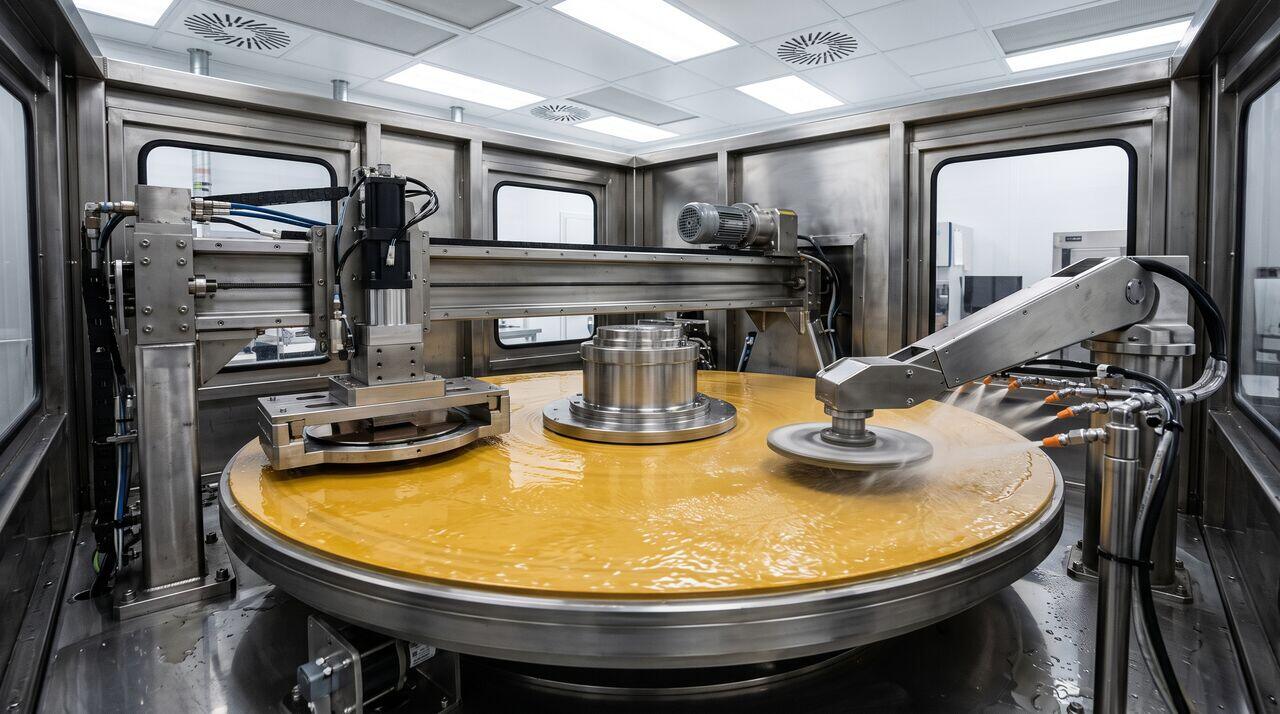
To reverse glazing, a rotating Diamond Conditioner Disk (a steel disk electroplated with synthetic diamond grit, ) is pressed onto the rotating pad surface under controlled load (). The diamond points cut micro-furrows into the polyurethane, stripping away the glazed layer and exposing fresh, open-pored asperities.
03Real-Time Process Monitoring: Endpoint Detection Systems
Polishing a target film (such as bulk copper or oxide) down to a underlying stop layer (such as tantalum nitride or silicon nitride) without over-polishing requires real-time Endpoint Detection (EPD).
Primary EPD Technologies
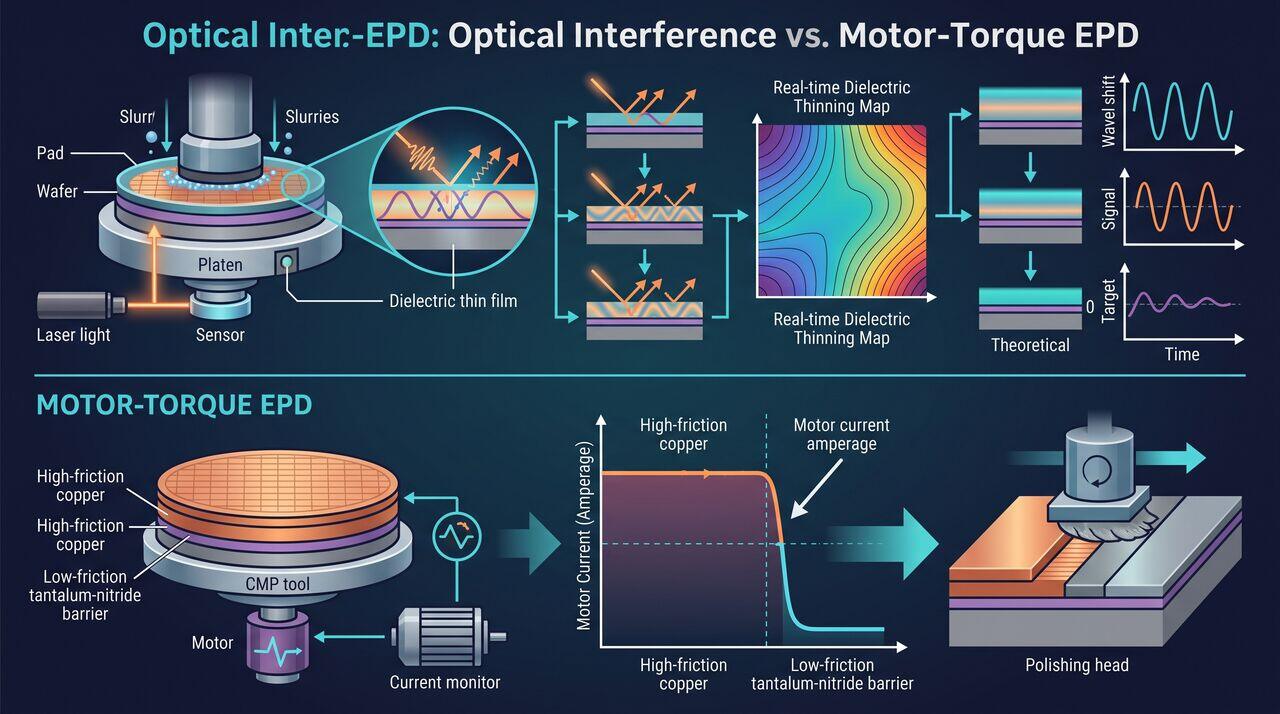
- Optical Reflection Endpoint (In-Situ Optical Metrology): A monochromatic laser or broadband LED shines through a transparent quartz window embedded in the rotating platen. As the oxide film thins, light reflecting from the top surface and film-substrate interface produces constructive and destructive interference fringes. The fringe frequency maps directly to remaining film thickness.
- Motor Current Endpoint (Frictional Torque Metrology): Monitors the electrical current drawn by the platen drive motor. When polishing transitions from soft copper (high friction coefficient ) to hard tantalum barrier metal (low friction coefficient ), the required motor torque drops abruptly. The current step-down signals exact film clearing.
04Consumables & Metrology Summary Table
| Subsystem | Core Component | Operational Lifetime | Primary Failure Mode |
|---|---|---|---|
| Polishing Pad | Cast Polyurethane Foam | Wafers | Groove depth loss, elastic modulus degradation |
| Conditioner Disk | Electroplated Diamond Grit | Wafers | Diamond pull-out, diamond tip dulling/wear |
| Chemical Slurry | Colloidal Silica / Ceria in aqueous pH buffer | Point-of-Use (POU) recirculating loop | Particle agglomeration (Large Particle Counts, LPC) |
| Optical Metrology | Sapphire / Quartz Platen Window | Matches Pad Lifetime | Slurry staining, window scratching |
→Prerequisites & continue reading
Prerequisites: ["p03-t3.1-t1-oxide-polysilicon-cmp-fundamentals"]
Also in Topic 3.3, Slurry, Pad Conditioning & CMP Metrology:
Tier 2 · Pad Conditioning, Diamond Wear & Endpoint Metrology …Tier 3 · Colloidal Slurry Stability & Pad Asperity Kinetics: …