01ALD Chamber Architectures: Cross-Flow vs. Showerhead
ALD tools for wafer processing utilize two primary chamber geometries:
- Cross-Flow Reactors:
- Process gas enters horizontally from one side of a low-volume reaction chamber and flows parallel across the wafer to an opposing exhaust port.
- Advantages: Extremely small internal chamber volume (), enabling rapid gas replacement during nitrogen purge cycles ().
- Showerhead / Vertical Laminar Reactors:
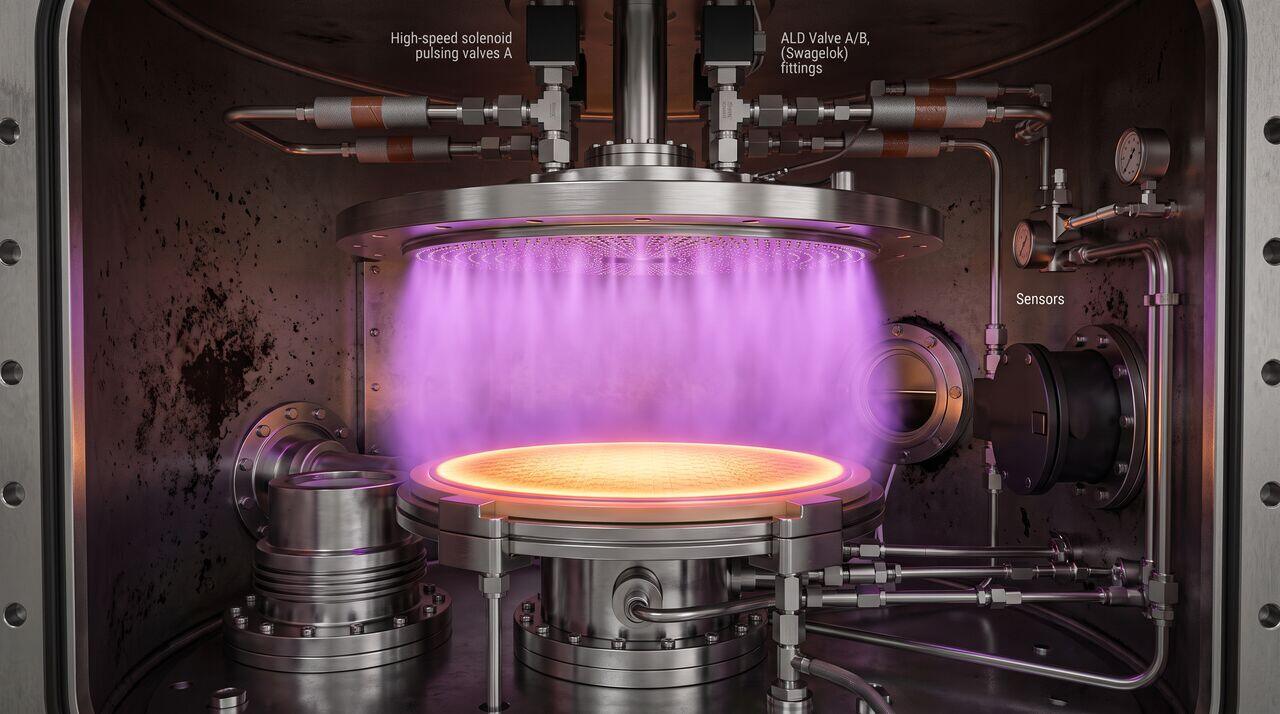
- Process gas enters vertically through a multi-orifice showerhead plate directly above the heated wafer chuck.
- Advantages: Superior radial thickness uniformity () across large substrates, widely adopted for High-k Metal Gate and 3D NAND gap fill.
02Precursor Gas Delivery & Fast High-Speed Pulsing Valves
Common precursors for high-k and metal gate deposition include:
- Hafnium Precursors: Tetrakis(dimethylamino)hafnium (TDMAH) or Tetrakis(ethylmethylamino)hafnium (TEMAH).
- Oxygen Co-Reactants: Water vapor (), Ozone (), or Oxygen Plasma ().
- Metal Gate Precursors: Titanium Tetrachloride () or Alkylamido-titanium with Ammonia () for TiN.
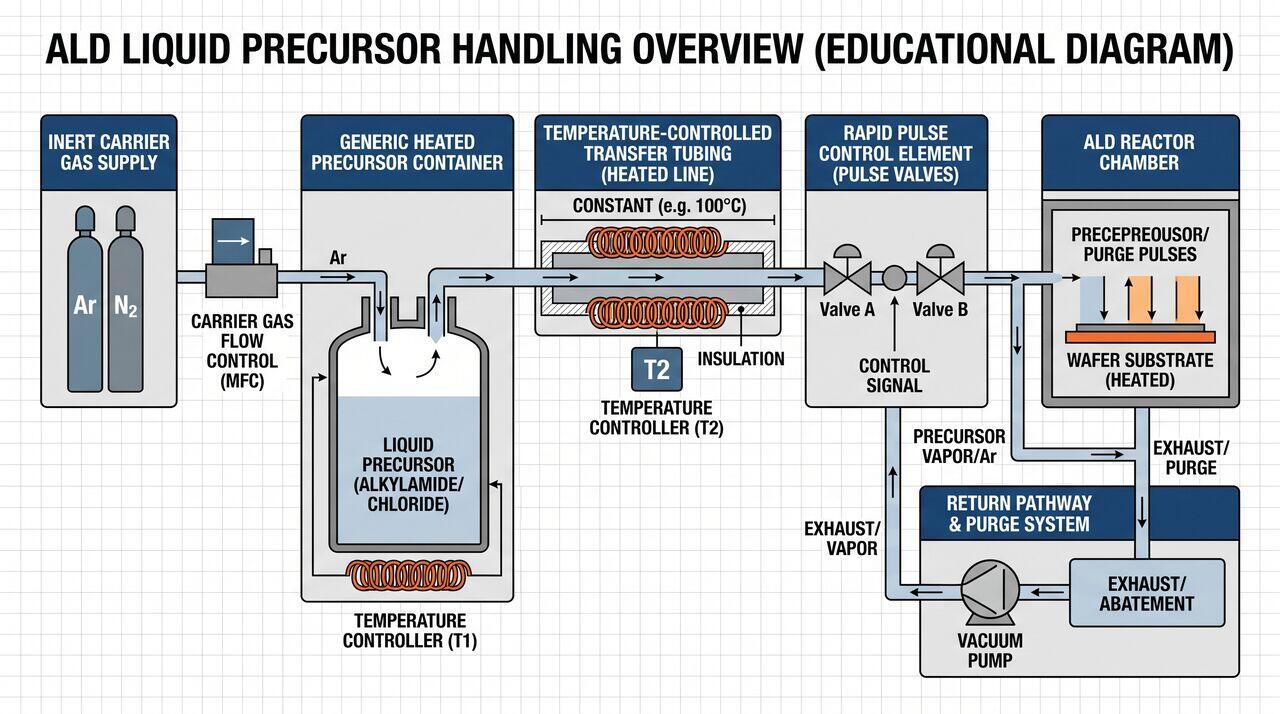
Because TDMAH and TEMAH are low-vapor-pressure liquids at room temperature, they are housed in heated stainless steel ampoules () and delivered using an inert Carrier Gas (Ar or ) with heated gas lines () to prevent precursor condensation.
High-Speed ALD Pulse Valves:
Specialized pneumatic or solenoid valves are rated for over switching cycles. They feature ultra-low internal dead volume and response times under to deliver precise micro-doses of precursor into the process chamber.
03Thermal ALD Temperature Window vs. PEALD
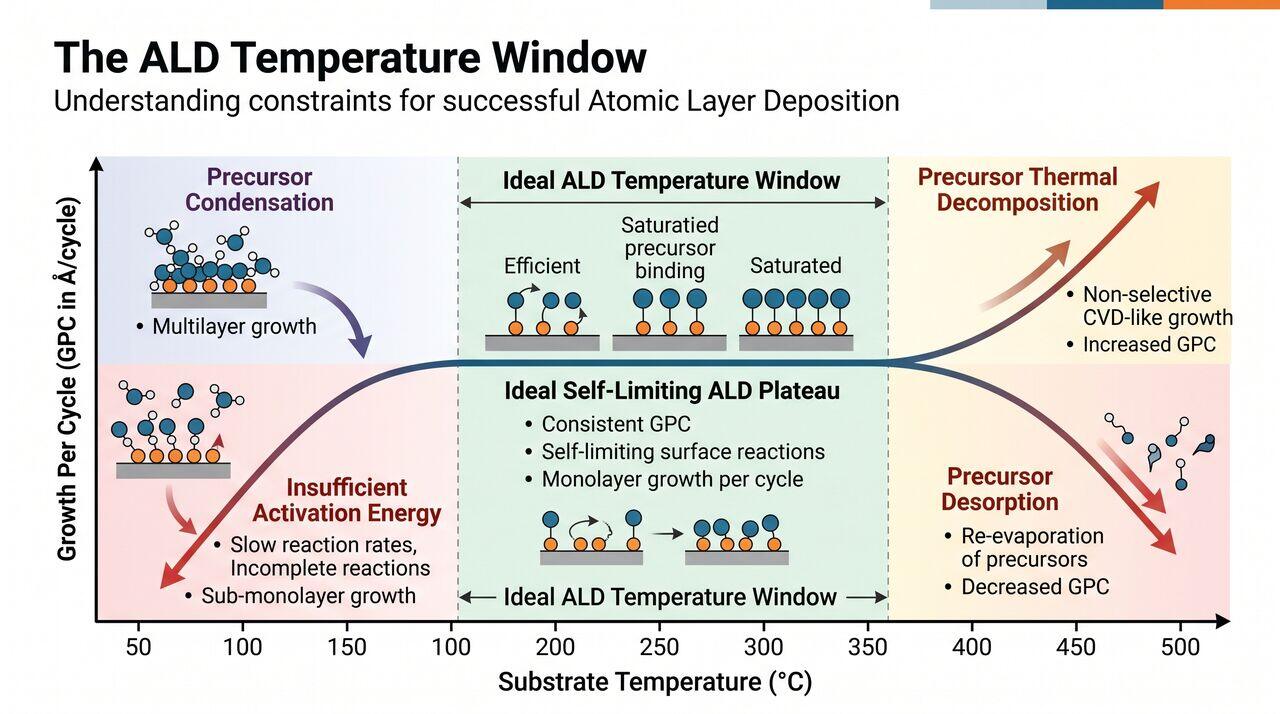
The ALD Temperature Window defines the operating regime where self-limiting monolayer growth occurs:
- Too Low (): Precursor condenses physically on the substrate, breaking self-limiting control and creating excess impurity concentration.
- Too High (): Precursor molecules thermally decompose (acting like un-controlled CVD) or desorb from surface sites before reacting.
Plasma-Enhanced ALD (PEALD):
By substituting thermal with reactive oxygen radicals generated by a Capacitively Coupled Plasma (CCP) or Inductively Coupled Plasma (ICP) source, PEALD expands the process window down to , enabling high-k deposition on temperature-sensitive substrates and organic photoresists.
→Prerequisites & continue reading
Prerequisites: ["p07-t7.2-t1-ald-high-k-metal-gate-fundamentals"]
Also in Topic 7.2, ALD & High-k Metal Gate Stacks:
Tier 1 · Atomic Layer Deposition (ALD) & High-k Metal Gate (H…Tier 3 · Interface Engineering, Dipole Formation & Work Funct…