01Vertical vs. Horizontal Furnace Architecture
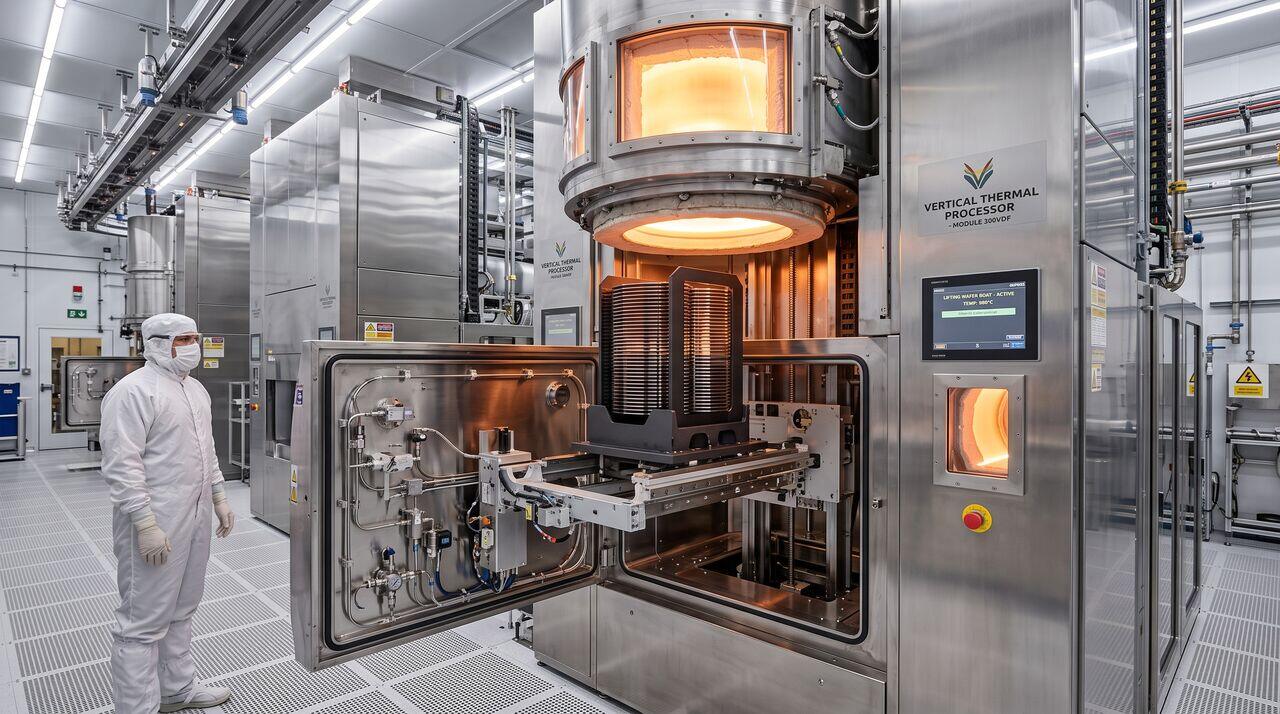
Modern fabs have almost universally transitioned from legacy horizontal diffusion furnaces to Vertical Thermal Processing (VTP) systems.
| Hardware Parameter | Horizontal Furnace | Vertical Furnace (VTP) |
|---|---|---|
| Wafer Orientation | Vertical, standing edge-on | Horizontal, stacked flat |
| Footprint | Large lateral cleanroom footprint | Small vertical footprint |
| Air Ingress & Particles | High risk during boat loading | Low risk (bottom-loading with load lock) |
| Thermal Uniformity | Natural convection causes top/bottom gradient | Rotational symmetry eliminates radial gradients |
| Automation | Manual / robotic pusher arm | Integrated atmospheric load port and boat elevator |
02Temperature Control & Heating Elements
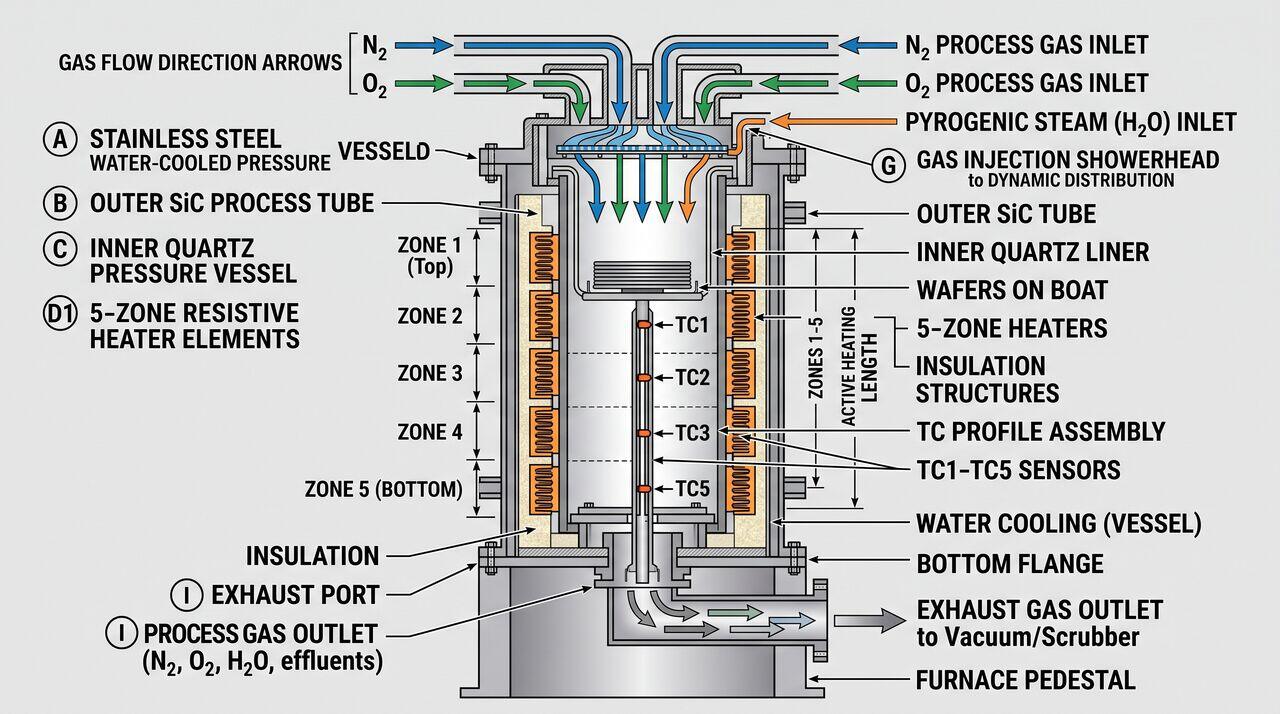
VTP systems utilize multi-zone resistive heating elements (typically 3 to 5 independent zones) encased in high-grade ceramic insulation:
- Top, Middle, and Bottom Heating Zones: Controlled independently via proportional-integral-derivative (PID) algorithms linked to internal thermocouple arrays.
- Spike Thermocouples: Positioned between the heating element and process tube to measure element response.
- Profile Thermocouples: Placed inside the process tube directly adjacent to the wafer load for real-time wafer temperature feedback.
High-purity Silicon Carbide (SiC) process tubes and boats are preferred over fused quartz for temperatures exceeding due to SiC's superior resistance to thermal sag, chemical corrosion, and alkali metal ion sodium () migration.
03Gas Delivery & Pyrogenic Steam Generation
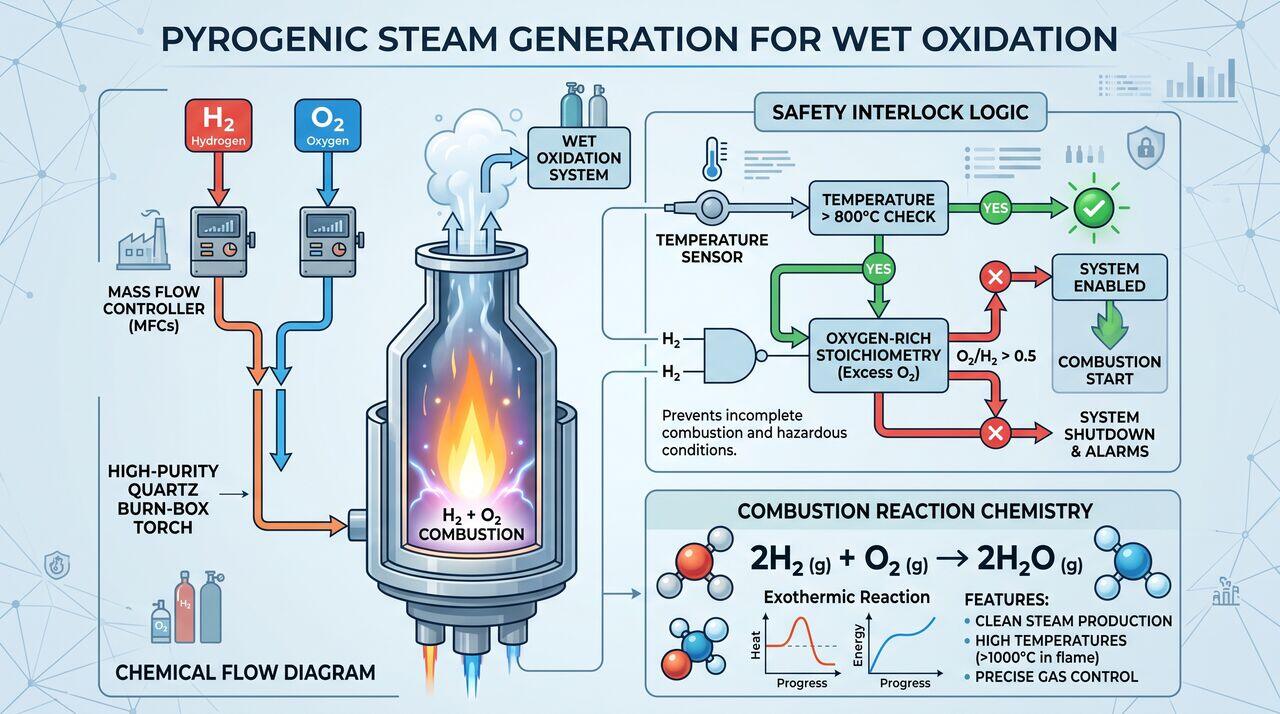
For wet oxidation, liquid cannot be directly injected without causing thermal shock and droplets. Instead, furnaces use a Pyrogenic Steam Generator (Torch):
- High-purity and gases are ignited in an external quartz combustion chamber.
- Gas ratios are maintained with excess () to prevent unreacted hydrogen from accumulating in the furnace exhaust, eliminating explosion hazards.
→Prerequisites & continue reading
Prerequisites: ["p07-t7.1-t1-thermal-oxidation-deal-grove-fundamentals"]
Also in Topic 7.1, Thermal Oxidation & Gate Dielectric Growth:
Tier 1 · Thermal Oxidation Fundamentals: Converting Silicon t…Tier 3 · Deal-Grove Oxidation Kinetics & Stress-Induced Thin …