01Dry vs. Wet Thermal Oxidation
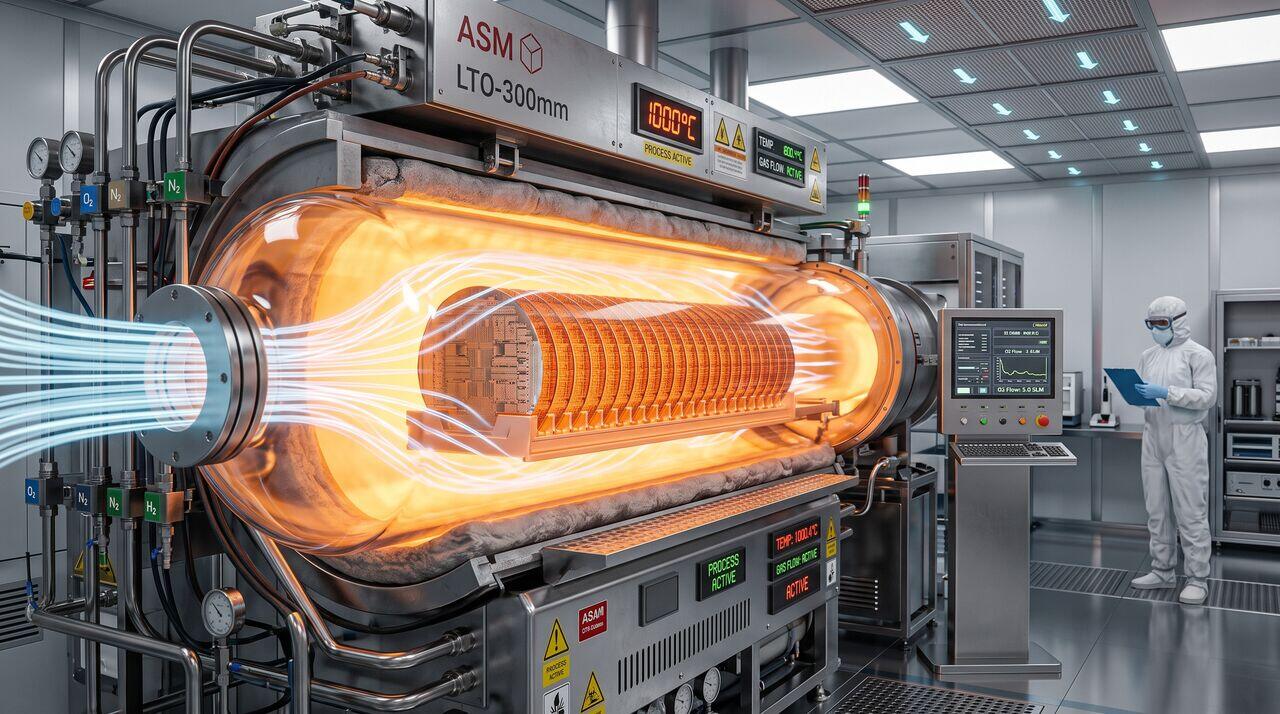
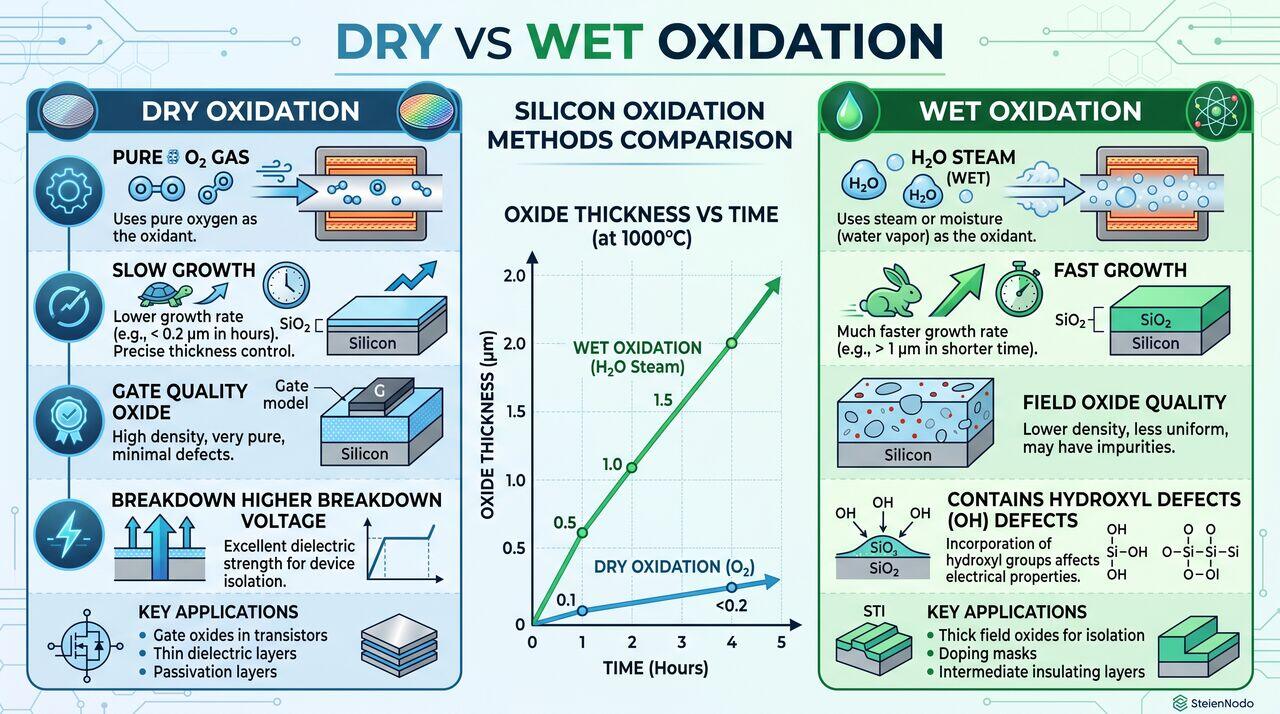
There are two primary modes of thermal oxidation in high-temperature furnaces:
- Dry Oxidation ():
- Characteristics: Slow growth rate, extremely high electrical quality, low defect density, high dielectric breakdown strength ().
- Applications: Gate oxides, thin dielectric liners, interface passivation layers.
- Wet Oxidation ( / Pyrogenic Steam):
- Characteristics: Rapid growth rate (approx. 5 to 10 times faster than dry oxidation), lower film density, higher defect count due to hydroxyl (-OH) incorporation.
- Applications: Thick field oxides, masking layers, shallow trench isolation liners.
02Silicon Consumption Mechanics
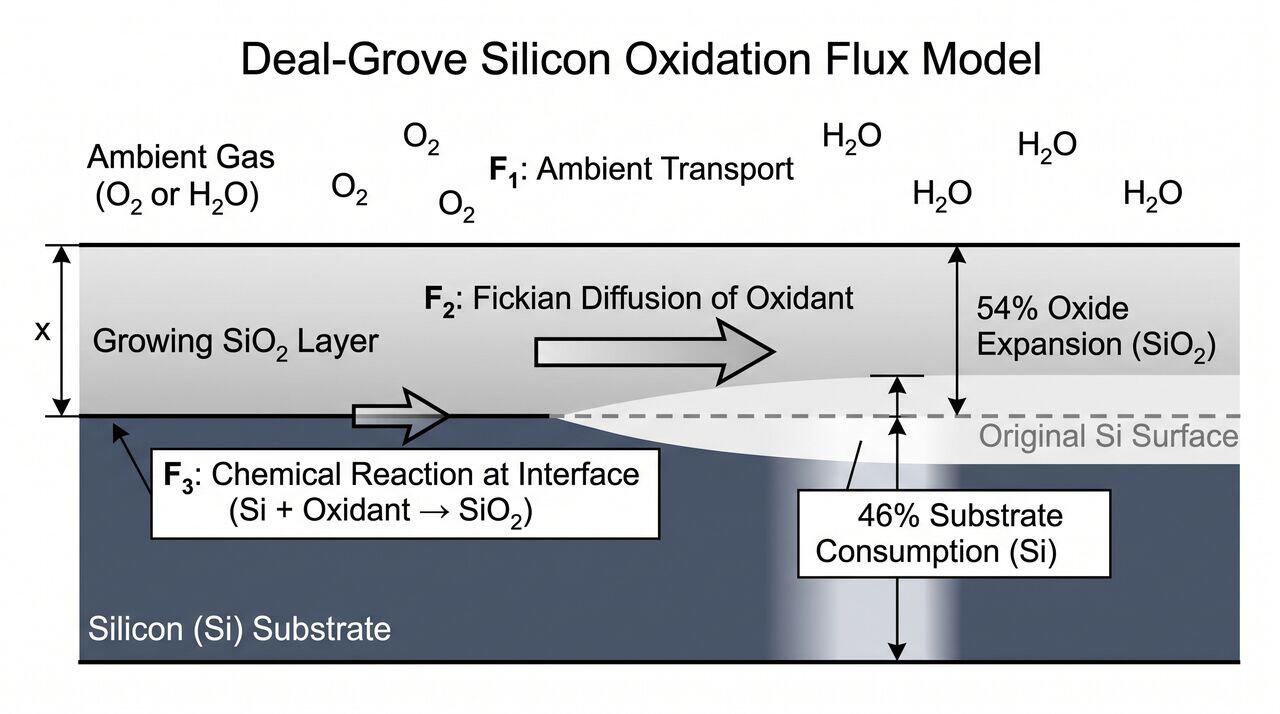
When grows, oxygen species diffuse through the existing oxide layer to react with silicon atoms at the interface.
Because the molecular volume of () is larger than the atomic volume of elemental silicon (), the growing oxide expands:
- of the final oxide thickness penetrates down into the original silicon substrate.
- of the oxide grows upward above the original surface plane.
If a process grows of , exactly of bulk silicon is consumed.
03The Deal-Grove Model Conceptual Overview
In 1965, Bruce Deal and Andrew Grove introduced the classic mathematical framework describing thermal oxidation kinetics. The model balances three consecutive flux steps:
- Transport Flux (): Transport of oxidizing species from the ambient gas to the outer oxide surface.
- Diffusion Flux (): Diffusion of oxidizing species through the existing layer to the interface.
- Reaction Flux (): Chemical reaction of oxidants with silicon at the interface.
At steady state (), the growth follows a transition from reaction-limited kinetics (linear growth for thin films) to diffusion-limited kinetics (parabolic growth for thick films).
→Prerequisites & continue reading
Prerequisites: ["p01-t1.1-t1-quartzite-to-mg-si-fundamentals"]
Also in Topic 7.1, Thermal Oxidation & Gate Dielectric Growth:
Tier 2 · Diffusion Furnace Tool Mechanics: Vertical/Horizonta…Tier 3 · Deal-Grove Oxidation Kinetics & Stress-Induced Thin …