01Mathematical Derivation of the Deal-Grove Equation
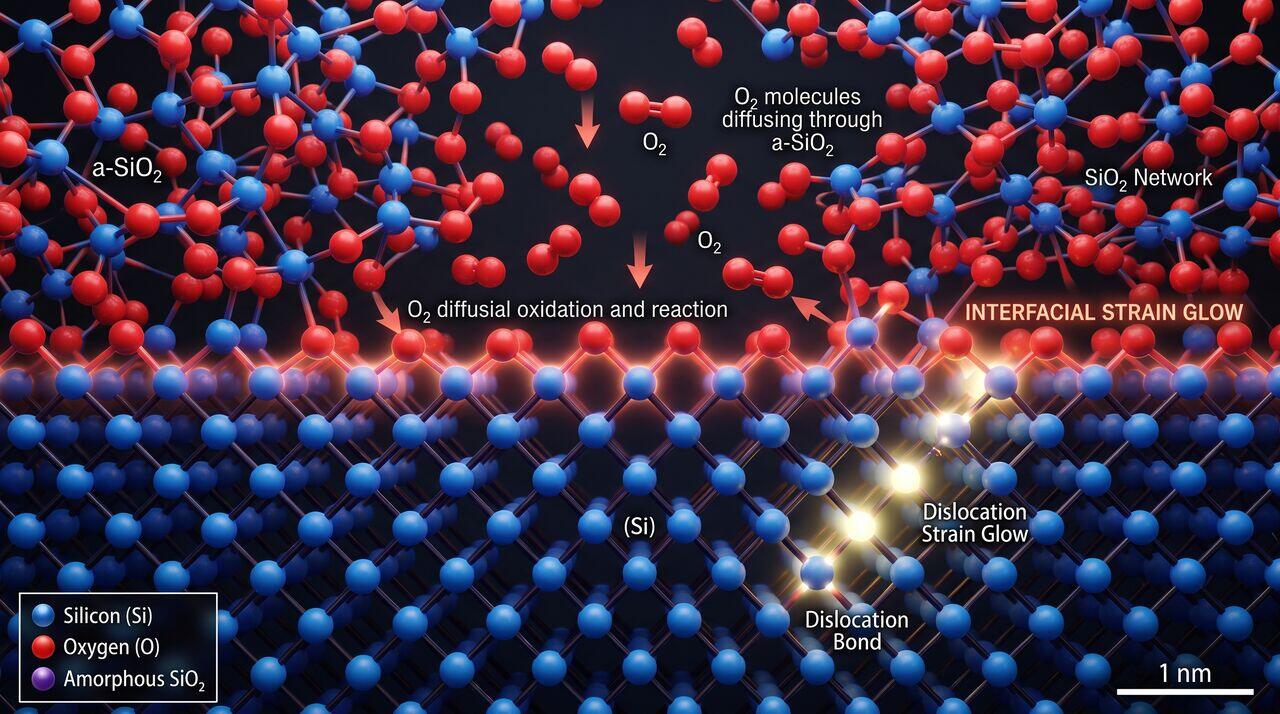
Consider an oxide film of thickness . The flux of oxidant molecules passing through the surface boundary layer (), diffusing through the oxide (), and reacting at the interface () are expressed as:
Where:
- is the gas-phase mass transfer coefficient.
- is the effective diffusion coefficient of oxidant in .
- is the chemical surface reaction rate constant at the interface.
- are oxidant concentrations in the bulk gas, at the surface, inside the top oxide surface, and at the interface, respectively.
Applying Henry's Law () and setting at steady state yields the differential equation for oxide growth:
Where is the number of oxidant molecules incorporated into a unit volume of ( for ). Integrating with initial condition yields the quadratic Deal-Grove equation:
Where:
Limiting Regimes:
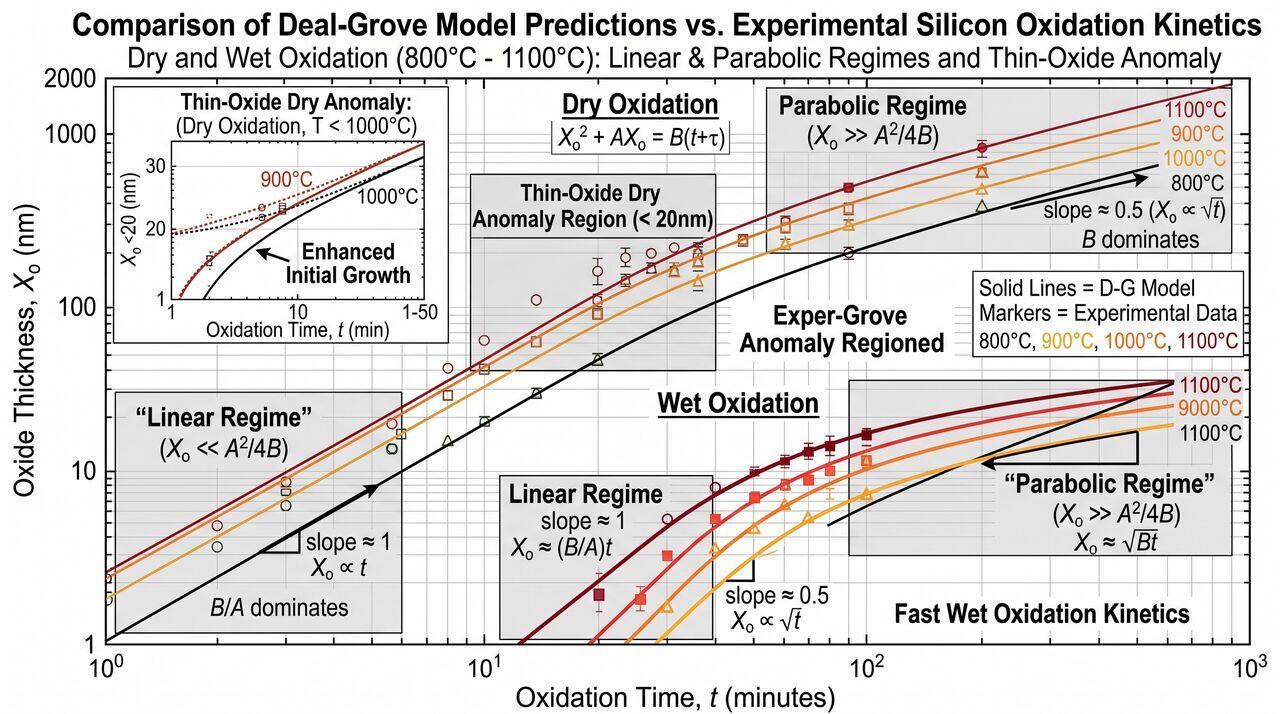
- Short Times / Thin Films (): Linear Regime
Controlled entirely by interface reaction rate .
- Long Times / Thick Films (): Parabolic Regime
Controlled entirely by oxidant diffusion through the bulk oxide.
02The Thin Oxide Anomaly & Extended Kinetic Models
For dry oxidation, experimental growth rates for are significantly faster than predicted by . An extra initial thickness must be added artificially to fit Deal-Grove parameters.
Several mechanisms explain this phenomenon:
- Space Charge & Oxygen Ion Solvation: Electric fields across ultra-thin oxides enhance ionic oxidant drift.
- Han-Masaoud Dual-Mechanistic Model: Proposes parallel diffusion of atomic oxygen radicals () alongside molecular .
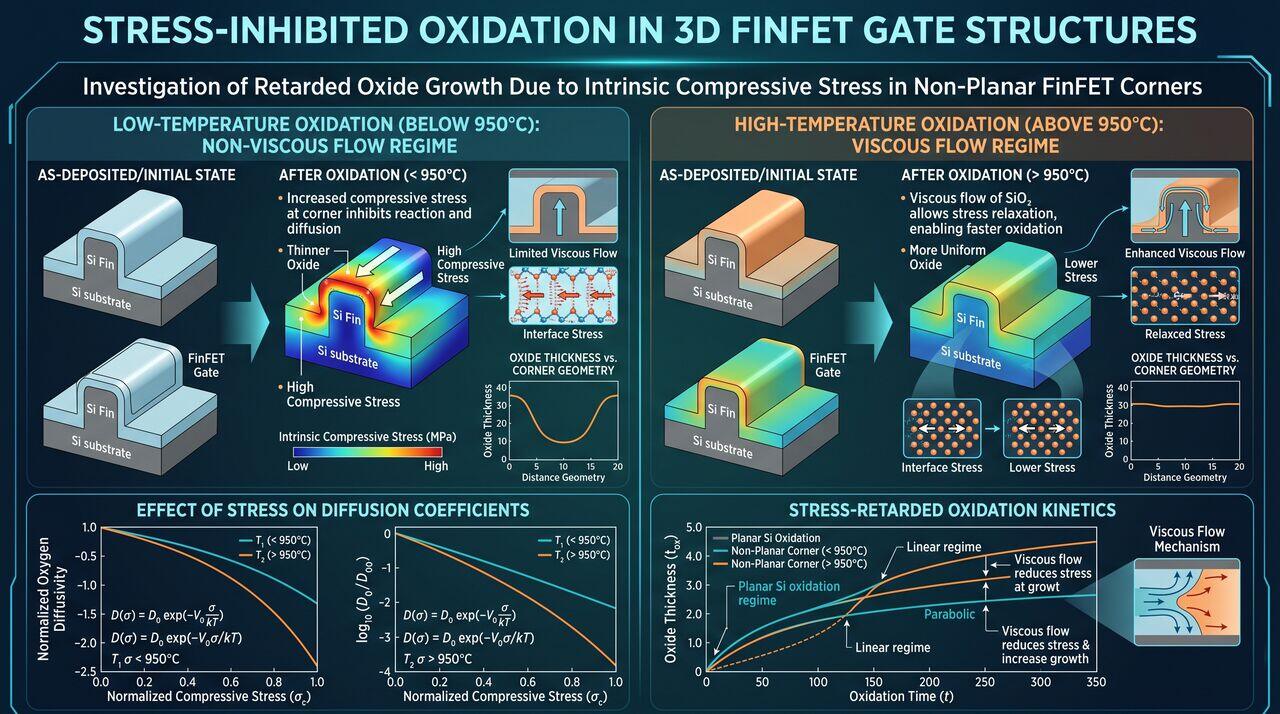
- Kao Stress-Dependent Model: Viscous flow of occurs above the transition temperature (). Below , high compressive intrinsic stress builds at non-planar silicon corners, suppressing and .
→Prerequisites & continue reading
Prerequisites: ["p07-t7.1-t2-diffusion-furnace-dry-wet-oxidation-mechanics"]
Also in Topic 7.1, Thermal Oxidation & Gate Dielectric Growth:
Tier 1 · Thermal Oxidation Fundamentals: Converting Silicon t…Tier 2 · Diffusion Furnace Tool Mechanics: Vertical/Horizonta…