01Czochralski Crystal Puller Hardware Architecture
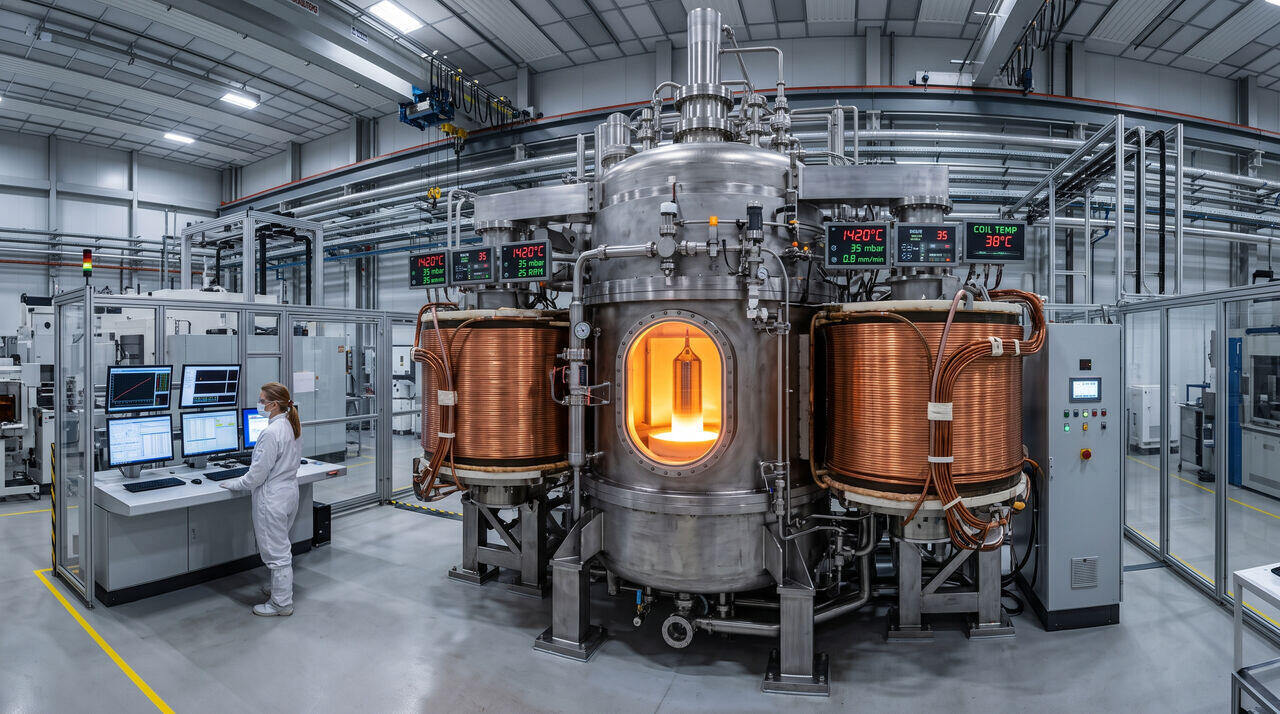
Modern 300mm Czochralski (CZ) pullers are towering precision furnace systems standing over tall, capable of maintaining sub-millimeter position control and temperature stability over a 72-hour continuous growth run.
Critical Subsystems
- Quartz Crucible & Graphite Susceptor: High-purity synthetic quartz liner holding up to of silicon melt, supported by a heavy carbon-composite graphite susceptor bowl.
- Picket-Fence Graphite Resistance Heaters: Multi-zone cylindrical carbon heaters surrounding the crucible, supplied with up to of electrical power.
- Argon Gas Purge Subsystem: High-purity argon gas flows downward through the chamber at reduced pressures () to carry away volatile silicon monoxide () gas evaporating from the melt surface.
02Melt Convection Dynamics and Magnetic Czochralski (MCZ)
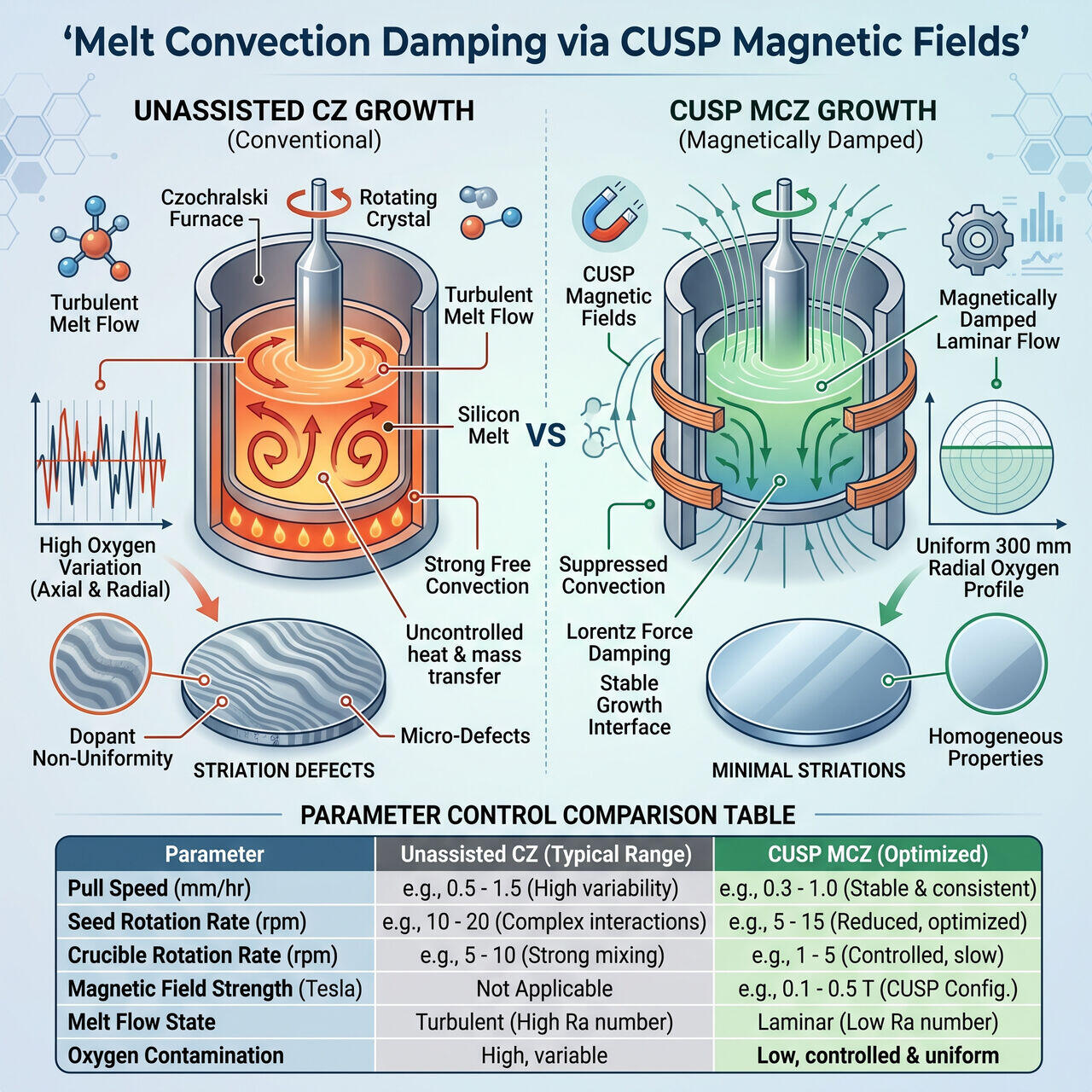
In a conventional CZ furnace, liquid silicon (a metallic conductor in its liquid state) exhibits turbulent natural convection driven by steep temperature differences between the outer crucible wall () and the central crystal interface ().
Turbulent convection causes thermal fluctuations at the growth interface, resulting in non-uniform dopant distribution and striations (microscopic ring defects).
The Solution: Magnetic Czochralski (MCZ)
By applying a strong external magnetic field (), Lorentz forces () act on the conductive molten silicon, creating an effective magnetic viscosity that damps out turbulent fluid motion.
03CUSP Magnetic Field Topology
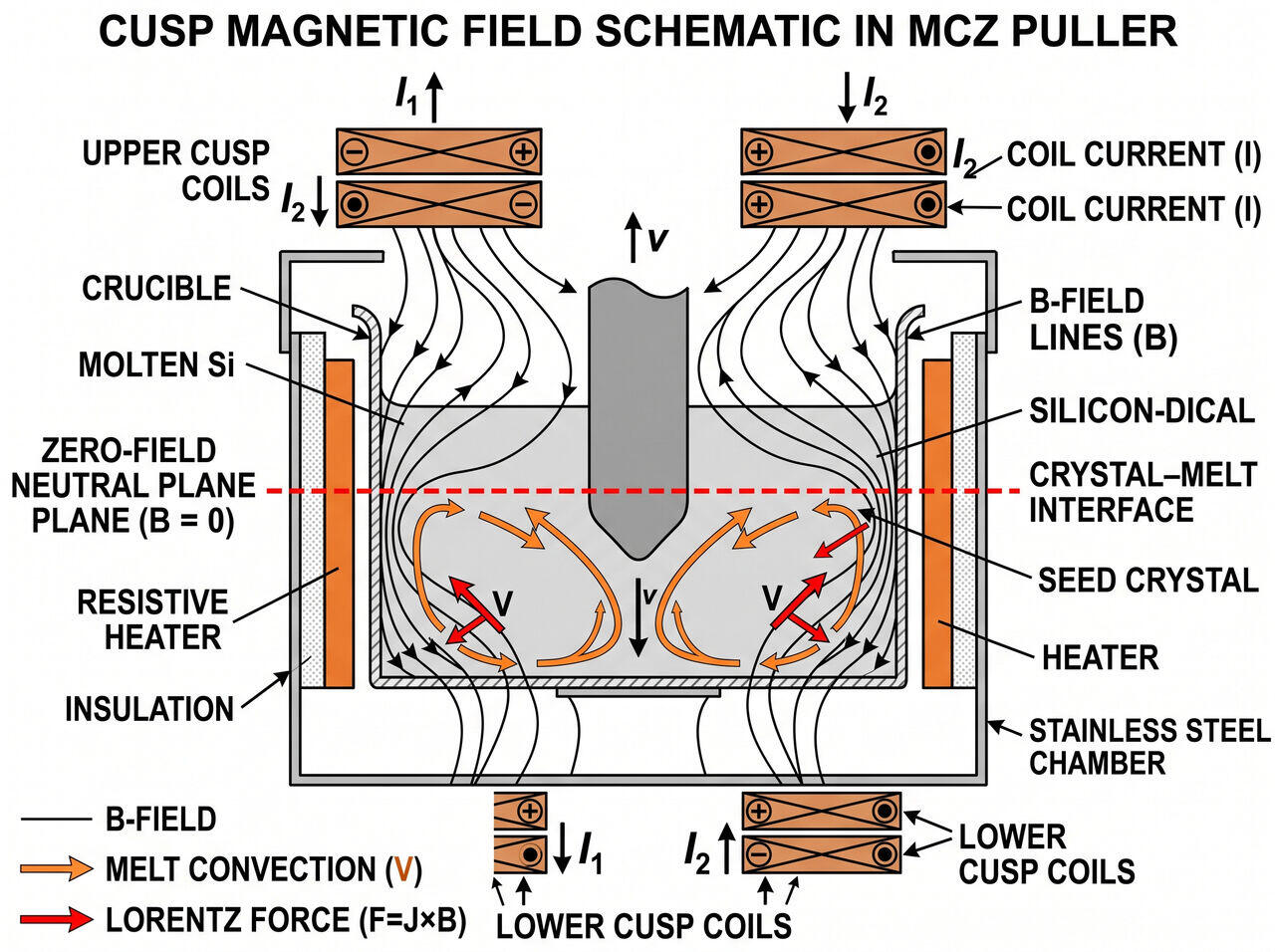
Among various magnetic configurations (Horizontal, Vertical, CUSP), the CUSP Magnetic Field topology is the industry gold standard for crystal growth.
How CUSP Mechanics Work
- Two Helmholtz-style electromagnets are positioned above and below the melt plane, carrying opposing electrical currents.
- This creates a magnetic field where the radial component is maximized near the melt surface and crucible walls, while the vertical magnetic field approaches zero directly at the central crystal growth interface.
- Benefits:
- Suppresses crucible wall erosion, reducing unwanted oxygen dissolution.
- Damps turbulent thermal plumes in the bulk melt.
- Preserves necessary forced convection beneath the crystal interface, ensuring uniform oxygen and dopant distribution across the wafer radius.
04Key Tool Operational Parameters
| Parameter | Nominal Control Window | Impact on Crystal Quality |
|---|---|---|
| Growth Pull Speed (v) | Controls crystal diameter and point defect formation (v/G ratio). | |
| Crystal Rotation () | (Clockwise) | Controls thermal symmetry and boundary layer thickness (). |
| Crucible Rotation () | (Counter-Clockwise) | Controls oxygen erosion rate from quartz crucible walls. |
| CUSP Field Strength (B) | Regulates melt convective damping and thermal turbulence. | |
| Argon Chamber Pressure | Prevents gas condensation on upper chamber walls. |
→Prerequisites & continue reading
Prerequisites: Understanding of CZ fundamentals (Topic 1.3 Tier 1) and basic electromagnetism
Also in Topic 1.3, Monocrystalline Growth: Czochralski & Float Zone:
Tier 1 · Growing the Perfect Single Crystal: Czochralski and …Tier 3 · Voronkov Criterion (v/G), Microdefect Control, and O…