01Introduction: The Origin of All Microelectronics
Every microchip powering modern artificial intelligence, supercomputers, and smartphones begins its journey as lump quartzite, an exceptionally high-purity form of quartz rock (). While silicon is the second most abundant element in the Earth's crust (making up roughly 28% of its mass), it never occurs naturally in its pure elemental state. Instead, silicon is tightly bound to oxygen in silicon dioxide () matrix formations.
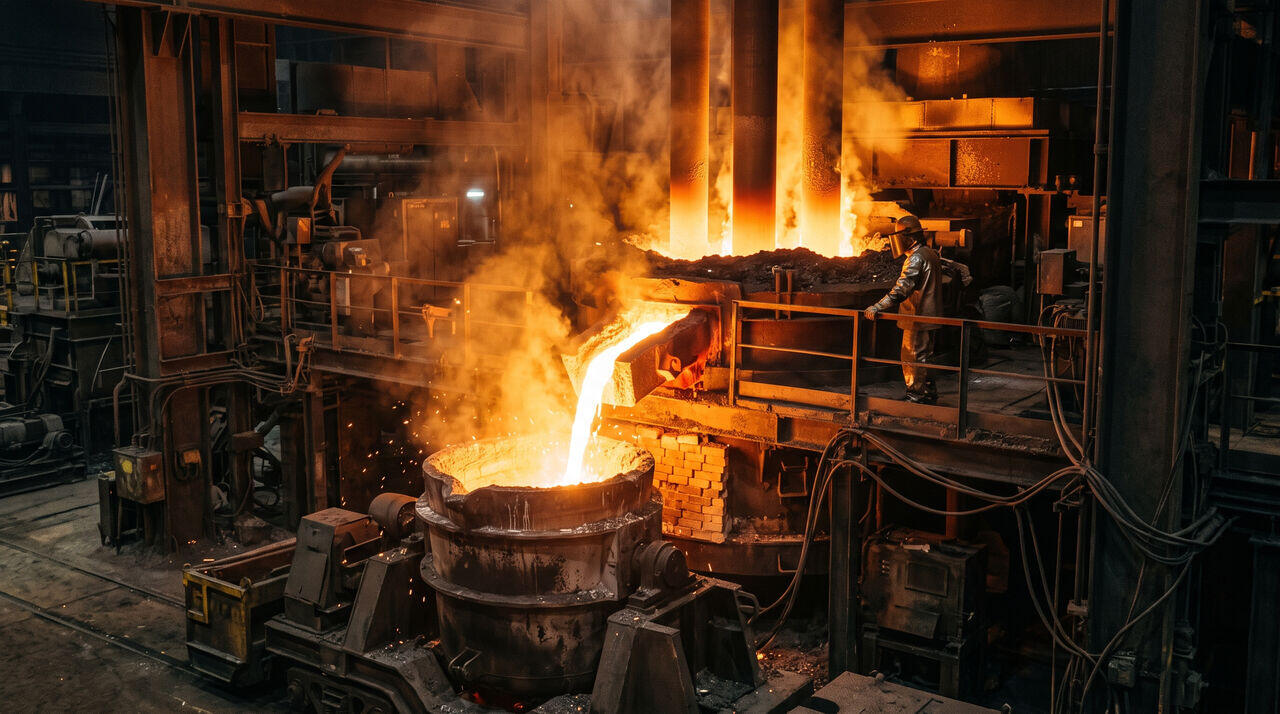
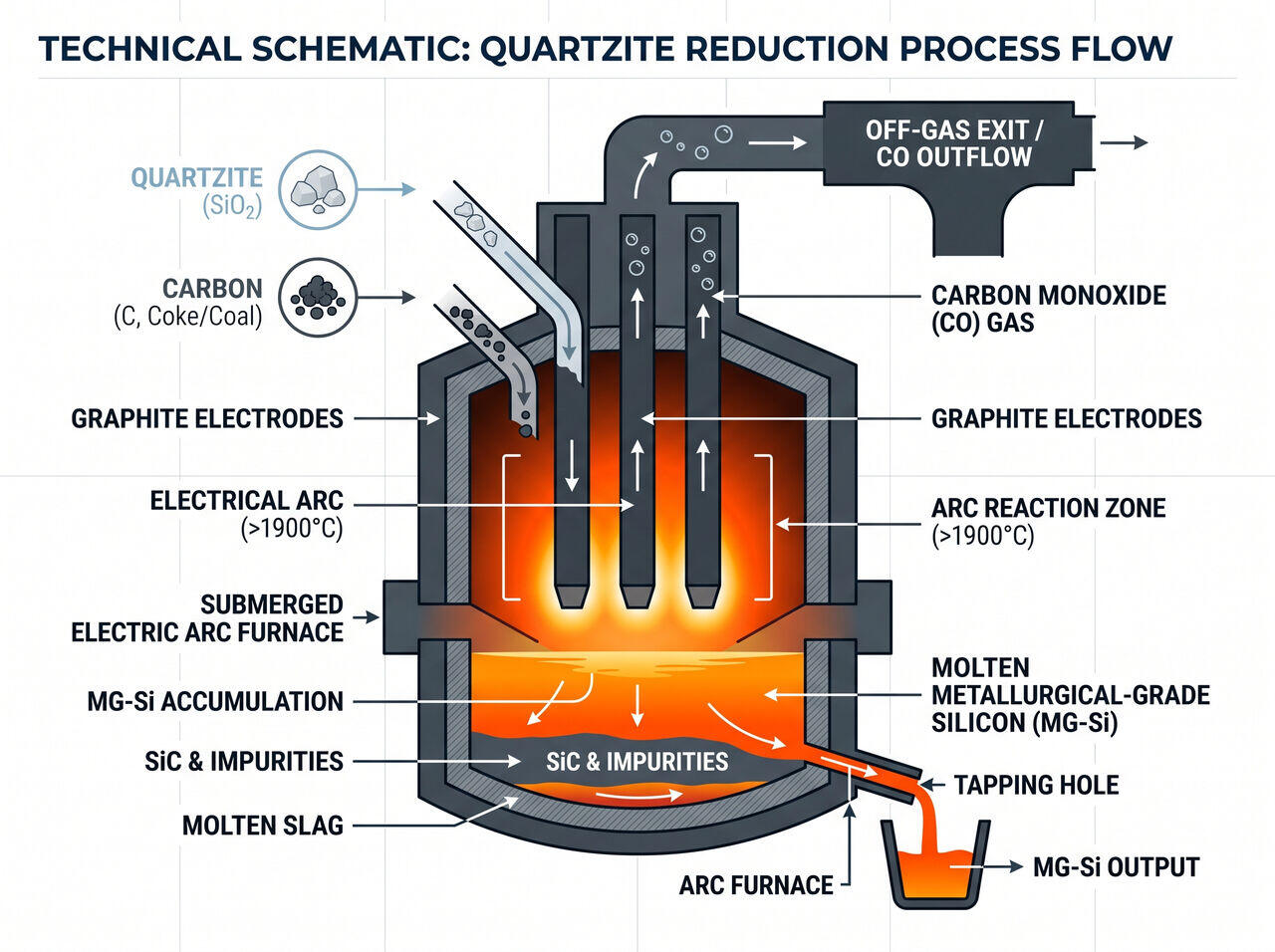
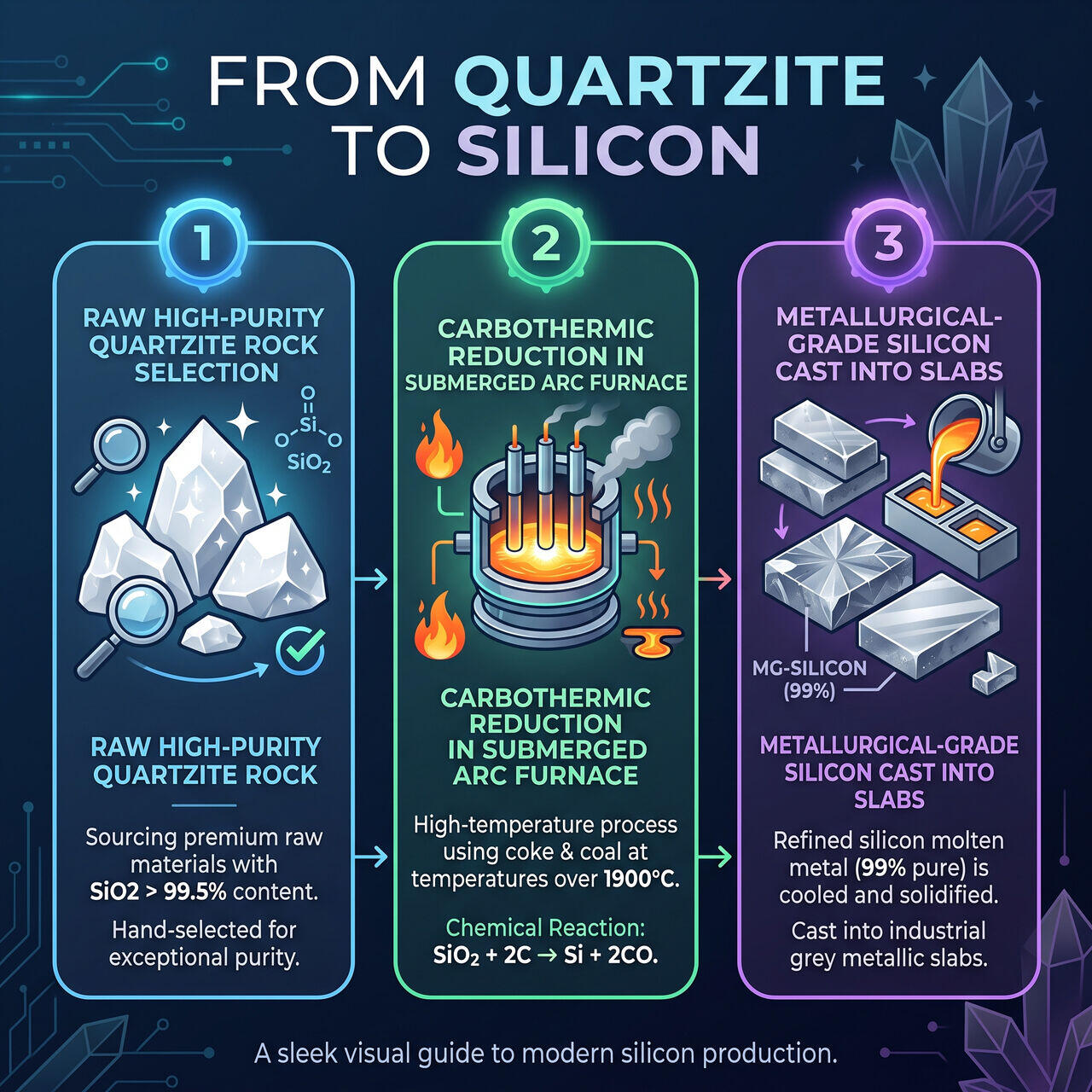
To extract pure elemental silicon, the silicon-oxygen bonds must be broken under extreme thermal conditions. This primary industrial extraction process is called carbothermic reduction, carried out inside massive submerged arc furnaces operating at temperatures exceeding .
02The High-Level Chemical Transformation
The net chemical reaction of carbothermic reduction appears straightforward on paper:
In practice, the transformation occurs through a complex multi-stage thermodynamic cascade inside the furnace shaft. Carbon reductants, typically a carefully measured blend of low-ash coal, petroleum coke, charcoal, and hardwood chips, act as chemical "oxygen scavengers." At temperatures above , carbon exhibits a higher thermodynamic affinity for oxygen than silicon does, stripping the oxygen atoms away to form carbon monoxide () gas and leaving behind molten elemental silicon.
Why Quartzite Quality Matters
Not all quartz rock can be used for semiconductor-grade silicon precursor manufacturing. High-purity quartzite deposits must meet strict chemical and physical specifications:
- High Purity: Minimum 99.5% silica content.
- Low Trace Metals: Minimal iron (), aluminum (), calcium (), and titanium ().
- Thermal Decrepitation Resistance: The rocks must not crumble or disintegrate into fine powder when exposed to sudden extreme heat, as fine powders block the upward flow of reaction gases inside the furnace.
03Product Characteristics: Metallurgical-Grade Silicon (MG-Si)
The output of this primary reduction process is Metallurgical-Grade Silicon (MG-Si), which exhibits a purity of approximately 98.5% to 99.5% (often referred to as "2N" purity, meaning two nines).
| Property | Metallurgical-Grade Silicon (MG-Si) Value |
|---|---|
| Purity Level | () |
| Major Impurities | Fe (), Al (), Ca () |
| Trace Impurities | Boron (), Phosphorus (), Titanium () |
| Primary Industry Destination | Aluminum alloys (55%), Chemical silanes (40%), Solar/Semiconductor precursors (5%) |
While 99% purity sounds high, it is vastly inadequate for microelectronics. A single gram of MG-Si contains trillions of metallic impurity atoms. These impurities act as electric shorts and recombination centers in transistors. Therefore, MG-Si serves merely as the crude raw material precursor for subsequent chemical refining steps.
04Key Takeaways & Summary
- Raw Source: Semiconductor manufacturing starts with high-purity quartzite rock (), not loose beach sand.
- Carbothermic Reduction: Submerged arc furnaces use carbon reductants at temperatures to strip oxygen from silica.
- Primary Output: The process yields Metallurgical-Grade Silicon (MG-Si) at ~98.5–99.5% purity.
- Next Step: MG-Si must undergo chemical conversion and fractional distillation to reach the "11N" () purity required for integrated circuits.
→Prerequisites & continue reading
Prerequisites: Basic high school chemistry (chemical equations, redox reactions)
Also in Topic 1.1, Quartzite Extraction & Carbothermic Reduction:
Tier 2 · Inside the Submerged Arc Furnace: Thermal & Electric…Tier 3 · Thermodynamics of Carbothermic Reduction and Impurit…