01Equipment Architectures: Immersion vs. Spin Processing
Semiconductor wet processing is broadly divided into two major tool architectures: Automated Batch Immersion Wet Benches and Single-Wafer Wet Cleaning Tools.
02Automated Batch Immersion Benches
In a batch immersion bench, 25 to 50 wafers held in a quartz or PFA cassette are simultaneously lowered into recirculating chemical baths.
A. Key Components
- Quartz / PFA Vessels: Chemical-resistant baths with overflow weirs to maintain liquid level and continuous filtration.
- Recirculation Loops: High-purity magnetic-drive pumps recirculation through sub-micron PTFE filters () at 20–40 L/min.
- In-Line Heating: Fluoropolymer heat exchangers maintain liquid temperatures within .
- Robotic Pick-and-Place (PTR): Programmable robots transfer wafer lots between chemical baths, DIW spray rinse tanks, and final drying stations.
B. Advantages & Limitations
- Throughput: High volume throughput (up to 250–500 wafers/hour).
- Cross-Contamination Risk: Dissolved impurities or particles shed from one wafer can potentially re-deposit on adjacent wafers in the same batch.
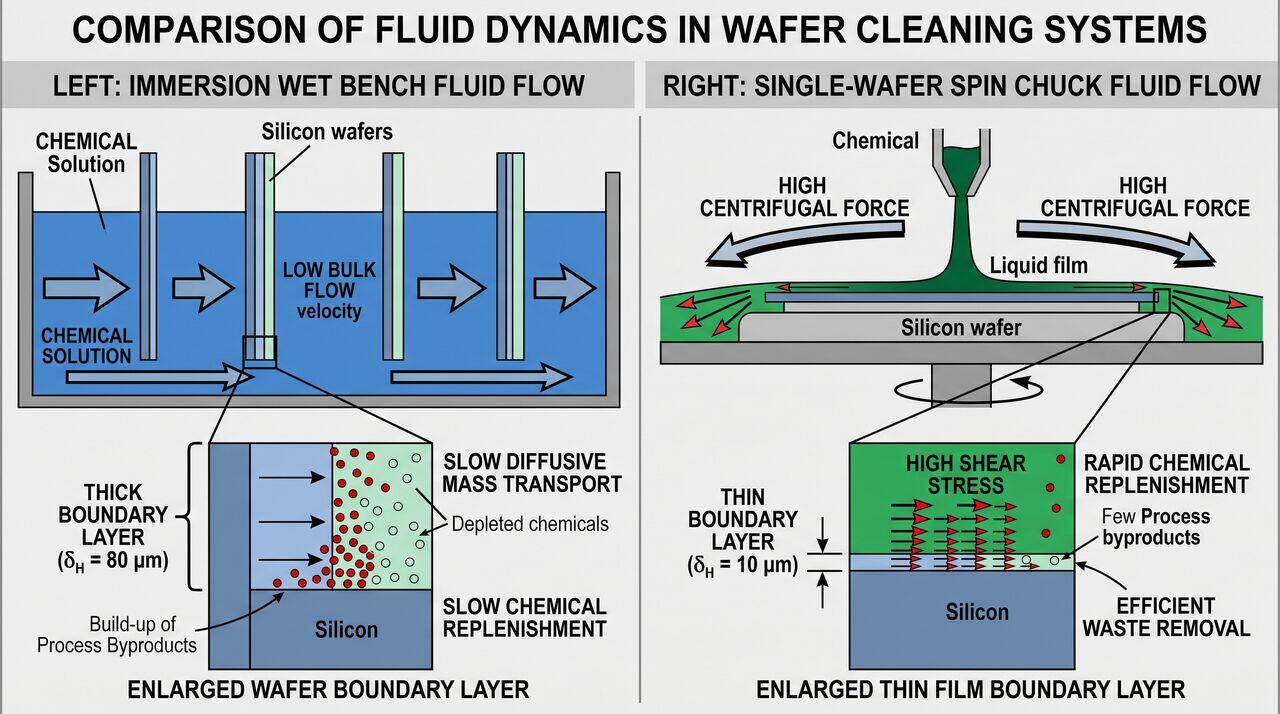
- Boundary Layer Thickness: Fluid flow across wafers in immersion is relatively slow, resulting in thick hydrodynamic boundary layers (), which limits mass transport of active reactants.
03Single-Wafer Spin Cleaning Tools
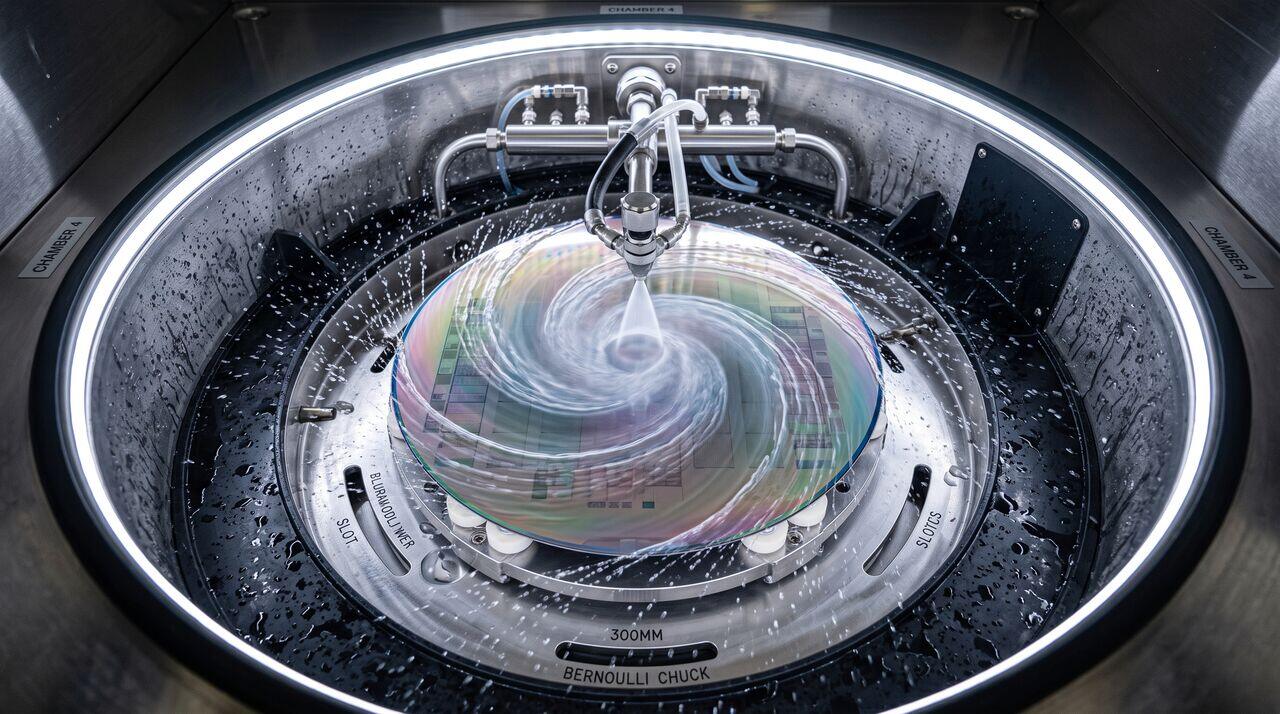
Single-wafer tools process one wafer at a time on a high-speed rotating chuck (1000–2000 RPM) while dispensing fresh, point-of-use chemicals through moveable spray nozzles.
A. Fluid Kinematics & Spin Hydrodynamics
Rotation creates strong centrifugal force, driving liquid outward in a thin liquid film (). The hydrodynamic boundary layer thickness is governed by rotation speed and kinematic viscosity :
At 1500 RPM, the boundary layer collapses to under , dramatically accelerating chemical diffusion and particle removal rates.
B. Advantages & Limitations
- Zero Cross-Contamination: Fresh chemical is applied to each wafer; spent chemical is immediately slung off to drain or reclaim.
- Short Process Times: Fast mass transport reduces reaction times from minutes to seconds per chemical step.
- Throughput Challenge: Lower raw throughput per chamber, requiring multi-chamber stacked architectures (e.g., 12 to 16 chambers per tool frame) to achieve commercial fab production rates.
04Hardware Comparison & Selection Matrix
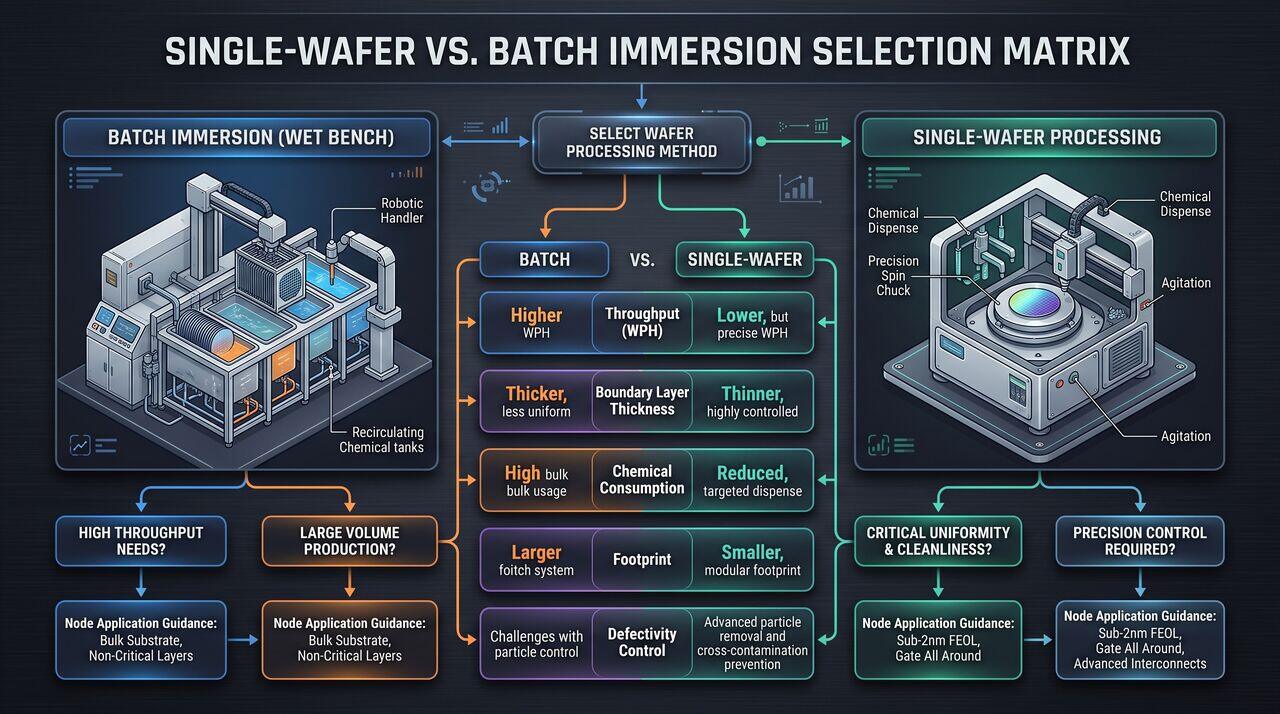
| Parameter | Batch Immersion Bench | Single-Wafer Spin Tool |
|---|---|---|
| Wafers Processed / Cycle | 25 - 50 wafers | 1 wafer (multi-chamber frame) |
| Boundary Layer () | ||
| Cross-Contamination Risk | Moderate (mitigated by weir flow) | Virtually Zero |
| Chemical Consumption | Low (bath recirculation, long bath life) | High (single-use or short-reclaim loops) |
| Target Application | Bulk wafer cleaning, initial substrate prep | Sub-2nm FEOL gate clean, BEOL delicate features |
→Prerequisites & continue reading
Prerequisites: RCA Clean Fundamentals, Fluid Mechanics Basics
Also in Topic 4.1, RCA Wet Cleans & Dilute Chemistry:
Tier 1 · RCA Clean Evolution & Dilute Chemistry Fundamentals…Tier 3 · Surface Oxidation & Chemical Etch Kinetics in SC-1/S…