01Thermodynamic & Kinetic Fundamentals of SC-1 Chemistry
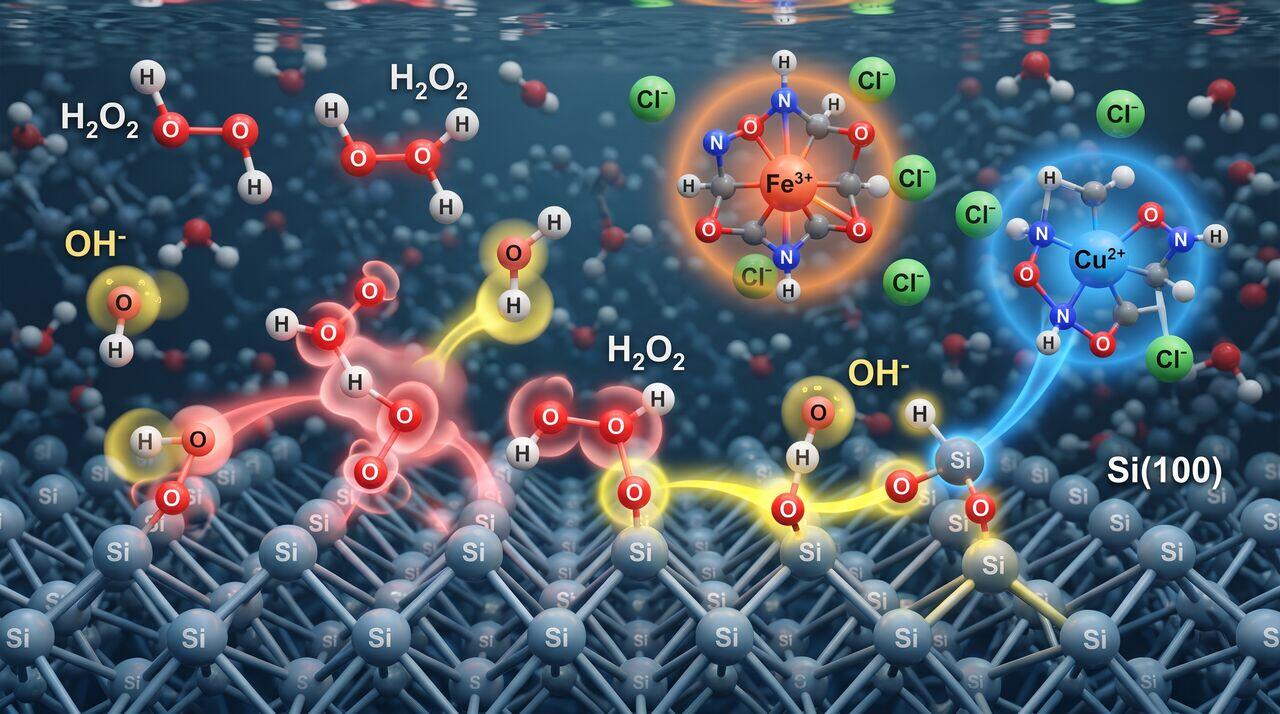
The Standard Clean 1 (SC-1) solution operates as a simultaneous oxidation and dissolution system. Hydrogen peroxide () acts as an oxidizing agent, while ammonium hydroxide () supplies hydroxyl ions () that etch the resulting oxide film.
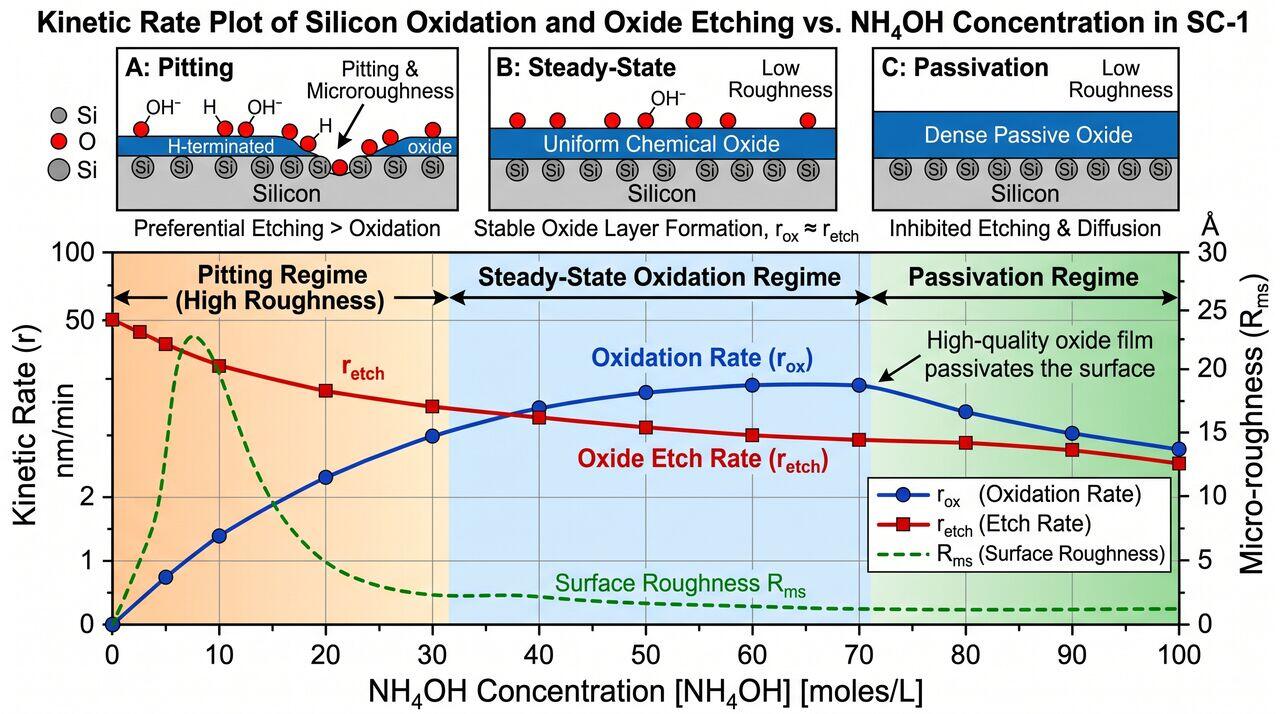
For steady-state cleaning without severe surface roughening, the oxidation rate and oxide etch rate must balance precisely.
02Chemical Reaction Kinetics in SC-1
A. Surface Oxidation Mechanism
Hydrogen peroxide decomposes on the silicon surface to yield reactive oxygen species ( or radicals):
B. Oxide Etching Mechanism
Hydroxyl ions () attack the silicon-oxygen bonds in the chemical oxide, converting insoluble into soluble silicate species:
If the concentration of is too high relative to , the native oxide layer becomes depleted (), exposing bare silicon directly to ions. This leads to anisotropic pitting along crystal planes, drastically increasing micro-roughness ().
03SC-2 Metal Solubilization & Redox Thermodynamics
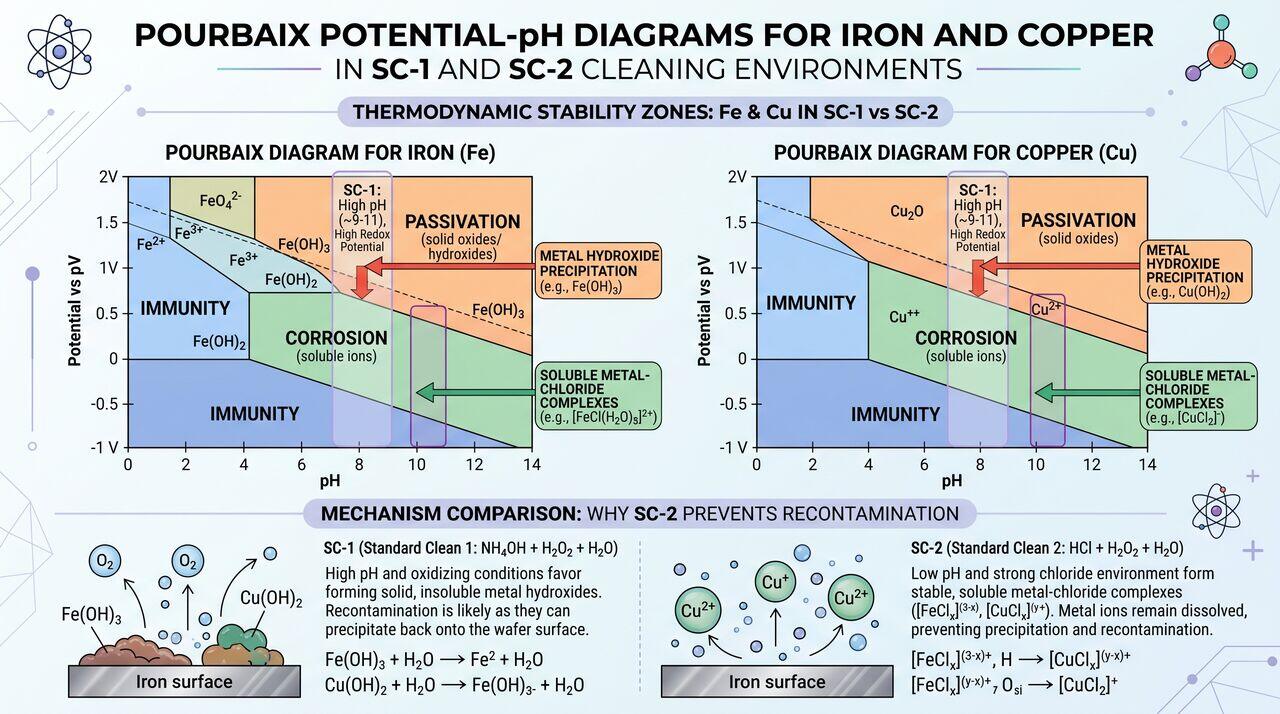
The SC-2 solution () removes trace transition metals () through oxidation and chloride complexation.
A. Metal Dissolution & Complexation Reactions
In an acidic peroxide medium, metallic contaminants are oxidized to their ionic states and immediately complexed by chloride ions:
The formation of stable, soluble chloro-complexes lowers the free metal ion activity , driving the dissolution equilibrium forward according to the Nernst Equation:
04Operational Parameter Optimization Matrix
| Defect / Objective | Chemical Lever | Kinetic Parameter | Process Risk |
|---|---|---|---|
| Prevent Surface Roughening | Lower ratio (0.05:1:5) | Maintain | Reduced organic etch rate |
| Prevent Metal Redeposition | Maintain pH < 2 in SC-2 | High redox potential () | Acid vapor corrosion of tool |
| Max Particle Lift-Off | Optimize SC-1 temp () | Etch depth | Over-etching gate oxide regions |
→Prerequisites & continue reading
Prerequisites: Electrochemical Kinetics, Physical Chemistry, Thermodynamics
Also in Topic 4.1, RCA Wet Cleans & Dilute Chemistry:
Tier 1 · RCA Clean Evolution & Dilute Chemistry Fundamentals…Tier 2 · Single-Wafer Spin Tools vs. Automated Batch Immersio…