01High-Level Purpose: Why Silicon Must Be Atomically Clean
In semiconductor manufacturing, a single microscopic particle or metallic impurity on a wafer surface can destroy an entire integrated circuit. For example, a 10 nm metallic impurity in a gate oxide layer causes electrical breakdown, while a micro-particle during photolithography creates killer defects (opens or shorts).
Before every high-temperature process (such as thermal oxidation or diffusion) and before film depositions (like ALD or CVD), silicon wafers must undergo rigorous chemical wet cleaning. The standard foundation for semiconductor wet cleaning is the RCA Clean, developed by Werner Kern at RCA Laboratories in 1965.
02The Core RCA Clean Reactions
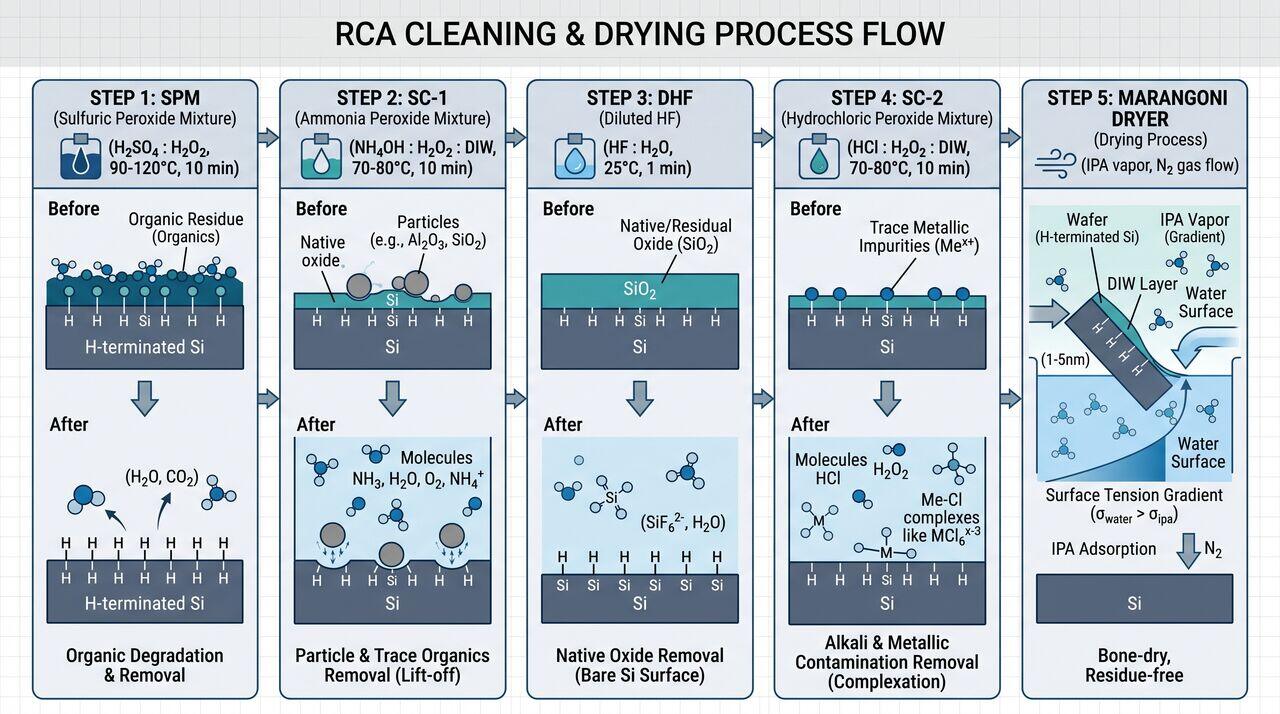
The traditional RCA clean consists of two primary chemical bath sequences, often separated or preceded by a dilute hydrofluoric acid (DHF) etch step:
A. Standard Clean 1 (SC-1) / Ammonia-Peroxide Mixture (APM)
- Chemical Composition: (originally 1:1:5, modern dilute formulations use 0.05:1:5 to 0.25:1:5).
- Operating Temperature: .
- Primary Function: Removal of organic contaminants and light particulate matter.
- Mechanism: Simultaneous oxidation of the silicon surface by hydrogen peroxide () and etching/dissolution of the resulting silicon dioxide by ammonium hydroxide (). This continuous "surface oxidation and etching" action undercuts particles, lifting them off the surface.
B. Dilute Hydrofluoric Acid (DHF) Step
- Chemical Composition: (1:50 to 1:500).
- Operating Temperature: Ambient ().
- Primary Function: Strip native chemical oxide () and trapped surface impurities, exposing a hydrophobic, hydrogen-passivated silicon surface ().
C. Standard Clean 2 (SC-2) / Hydrochloric-Peroxide Mixture (HPM)
- Chemical Composition: (originally 1:1:6, modern dilute formulations 0.1:1:6).
- Operating Temperature: .
- Primary Function: Removal of trace alkali metals () and heavy transition metals ().
- Mechanism: forms soluble metal-chloride complexes (e.g., ), preventing metal hydroxides from precipitating back onto the wafer surface.
03Industrial Evolution: From Concentrated to Dilute Chemistries
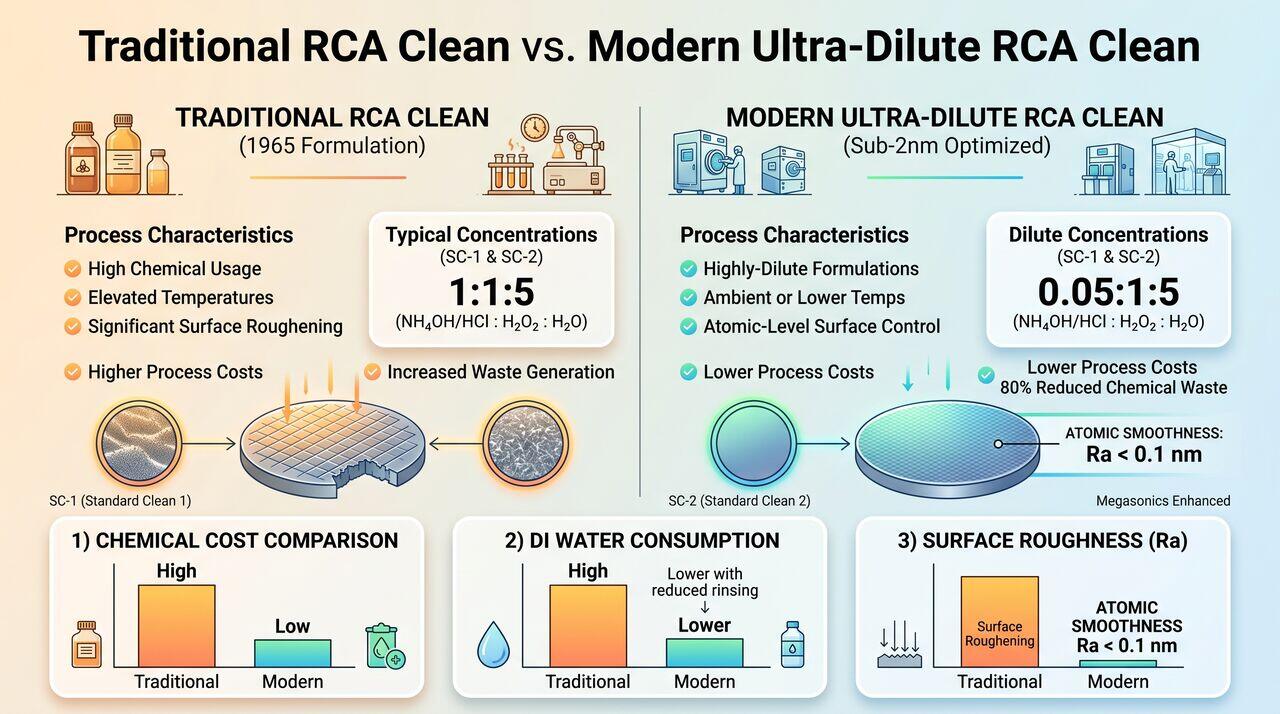
Modern sub-2nm fabs no longer use the original concentrated 1:1:5 RCA solutions. The transition to ultra-dilute chemistries yields major operational and technical benefits:
- Surface Roughness Control: High concentrations of etch silicon non-uniformly, increasing surface roughness (), which degrades gate oxide integrity (GOI). Dilute SC-1 preserves sub-angstrom smoothness ().
- Chemical Consumption & Cost: Dilute solutions reduce raw chemical consumption by up to , drastically lowering chemical procurement and deionized water (DIW) rinse costs.
- Environmental Impact: Lower ammonia emissions simplify fab exhaust scrubbers and wastewater neutralization.
04Key Process Parameters Summary
| Cleaning Step | Chemical Mixture | Temperature | Target Contaminants | Key Mechanism |
|---|---|---|---|---|
| SPM (Piranha) | (4:1) | Heavy photoresist / organics | Sulfuric oxidation & dehydration | |
| SC-1 (APM) | (0.1:1:5) | Organic residues, particles | Controlled oxide etch & particle lift-off | |
| DHF | (1:100) | Chemical oxide, trapped metals | Oxide dissolution & H-passivation | |
| SC-2 (HPM) | (0.1:1:6) | Alkali & transition metals | Metal-chloride solubilization |
→Prerequisites & continue reading
Prerequisites: Basic chemistry (acids/bases, redox reactions)
Also in Topic 4.1, RCA Wet Cleans & Dilute Chemistry:
Tier 2 · Single-Wafer Spin Tools vs. Automated Batch Immersio…Tier 3 · Surface Oxidation & Chemical Etch Kinetics in SC-1/S…