01Executive Summary
While Preston's equation describes CMP behavior at a macro-scale continuum level, it fails to explain micro-scale phenomena such as removal rate saturation at high pressures, non-linear abrasive concentration effects, or particle size dependence. To overcome these limitations, Luo and Dornfeld developed a fundamental tribological model based on elastic-plastic contact mechanics, pad asperity statistics, and active abrasive particle counts. This deep-dive monograph examines the Luo-Dornfeld model, solid-augmented chemical removal kinetics, and sub-micron abrasive contact physics in oxide and polysilicon CMP.
02Limitations of the Macro-Scale Preston Model
Preston's empirical equation () assumes a continuous, direct contact between two ideal flat surfaces. In reality:
- Contact occurs only at the discrete tips of rough polyurethane pad asperities.
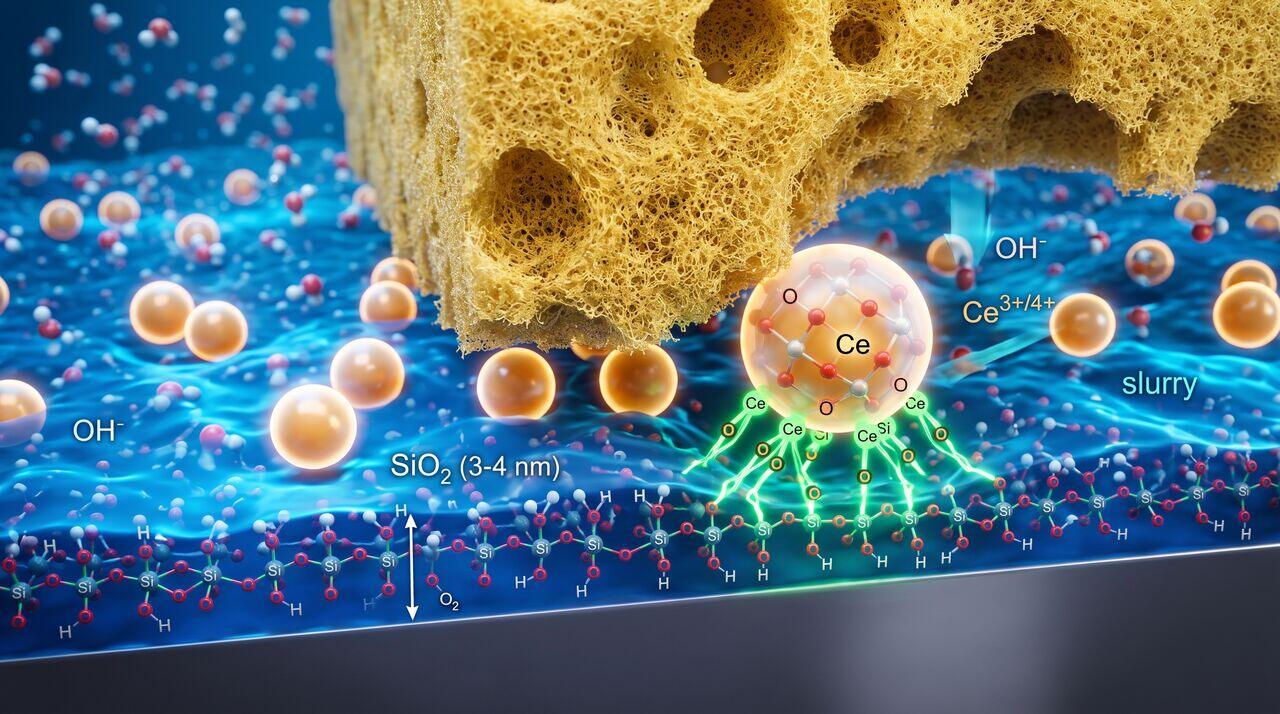
- Material removal is mediated by discrete abrasive nanoparticles () suspended in a liquid boundary layer.
- At elevated pressures, the removal rate deviates from linearity due to pad deformation, abrasive saturation, and slurry hydrodynamics.
03The Luo-Dornfeld Model Formulations
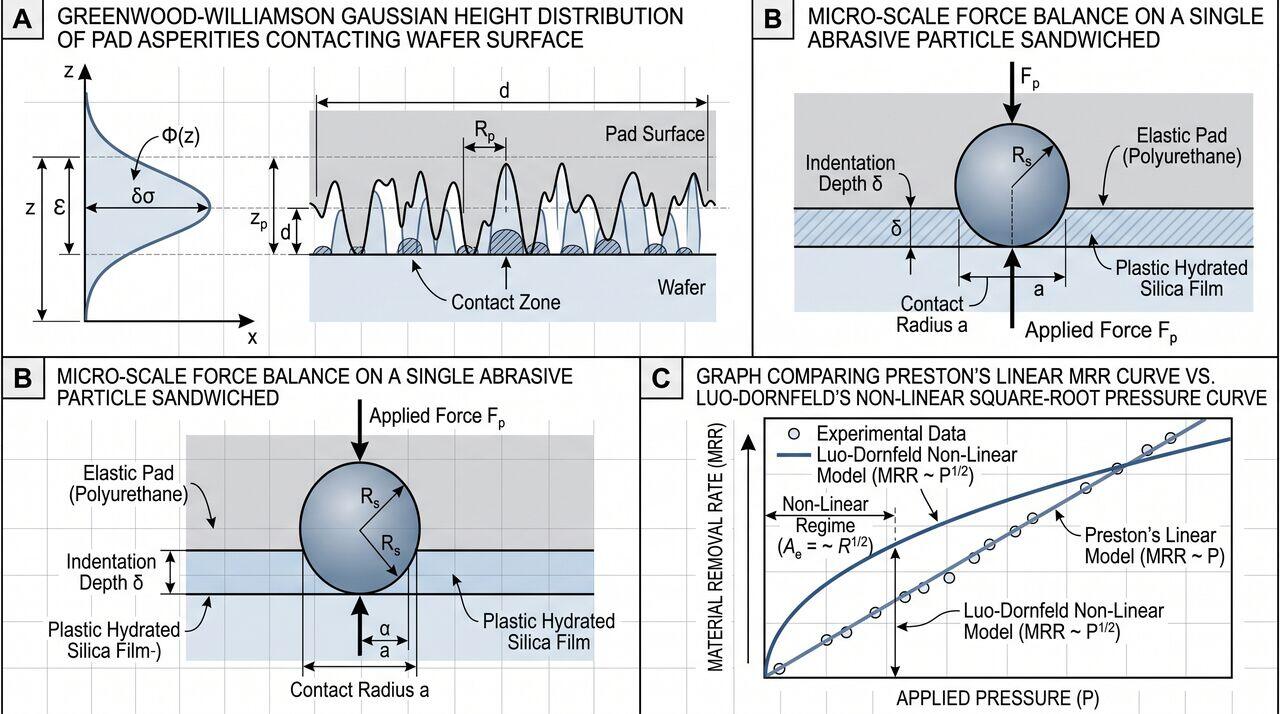
Luo and Dornfeld (2001) modeled material removal by integrating plastic indentation mechanics of individual abrasive particles with Greenwood-Williamson statistics for pad asperity heights.
2.1 Indentation Depth of a Single Particle
Assuming elastic deformation of the pad and plastic deformation of the wafer's soft hydrated surface layer, the indentation depth of an abrasive particle of diameter into the wafer surface is:
Where:
- is the local contact pressure exerted by a single pad asperity.
- is the hardness of the hydrated wafer surface layer.
- is a dimensionless constant incorporating the elastic moduli of the pad () and particle ().
2.2 Active Particle Density
Not all particles in the slurry contribute to polishing. Only particles trapped between pad asperities and the wafer surface (active particles ) cut material:
Where is the volumetric particle concentration in the slurry, and is the real contact area between pad asperities and the wafer ().
2.3 Comprehensive Luo-Dornfeld MRR Equation
Combining indentation volume per particle, relative velocity V, and active particle density yields the complete Luo-Dornfeld removal rate expression:
Where:
- captures the non-linear pressure saturation regime caused by pad elastic deformation.
- represents pure chemical dissolution in the absence of mechanical contact.
04Solid-Augmented Removal Dynamics in Ceria vs. Silica Slurries
The chemical nature of the abrasive particle fundamentally changes the removal mechanism:
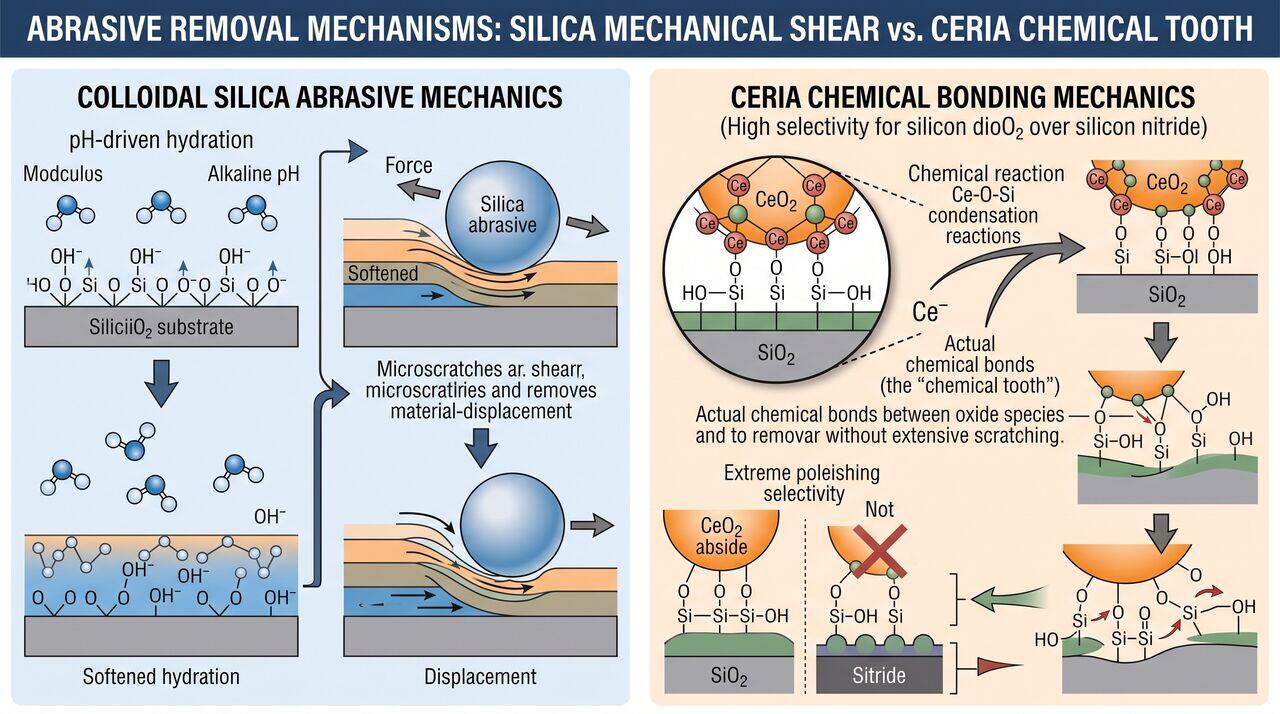
Colloidal Silica (): Mechanical Abrasion Dominant
Colloidal silica particles rely on mechanical shear to sweep away hydrated surface layers (). The interaction is non-selective, polishing silica, silicon nitride (), and polysilicon at similar rates depending on slurry pH.
Ceria (): Chemical Tooth Mechanism
Ceria particles exhibit a unique "chemical tooth" effect through chemical bonding between surface cerium atoms and silicon oxide molecules:
This formation of temporary bonds allows ceria abrasives to tear away entire silica molecular clusters with extremely low mechanical force, yielding exceptionally high oxide removal rates () while stopping completely on silicon nitride stopping layers ( selectivity >100:1).
05Quantitative Model Comparison
| Model Feature | Preston Model (1927) | Scire / Cook Model (1990) | Luo-Dornfeld Model (2001) |
|---|---|---|---|
| Primary Physics | Macro Continuum Kinematics | Glass Hertzian Contact | Elastic-Plastic Pad Asperity Contact |
| Pressure Dependence | Linear () | Linear () | Non-linear ( to ) |
| Particle Size Sensitivity | None ( constant) | Inverse proportional () | Proportional to indentation () |
| Pad Roughness Factor | Ignored | Ignored | Incorporates Greenwood-Williamson distribution |
| Predictive Accuracy | Baseline trend analysis | Polishing optics | High-precision sub-10nm CMP node design |
→Prerequisites & continue reading
Prerequisites: ["p03-t3.1-t2-prestonian-kinematics-cmp-tool-mechanics"]
Also in Topic 3.1, Oxide & Polysilicon CMP:
Tier 1 · Oxide and Polysilicon CMP Fundamentals: Achieving Gl…Tier 2 · Prestonian Kinematics & CMP Tool Architecture: Press…