01Mathematical Modeling of Aspect Ratio Dependent Etching (ARDE)
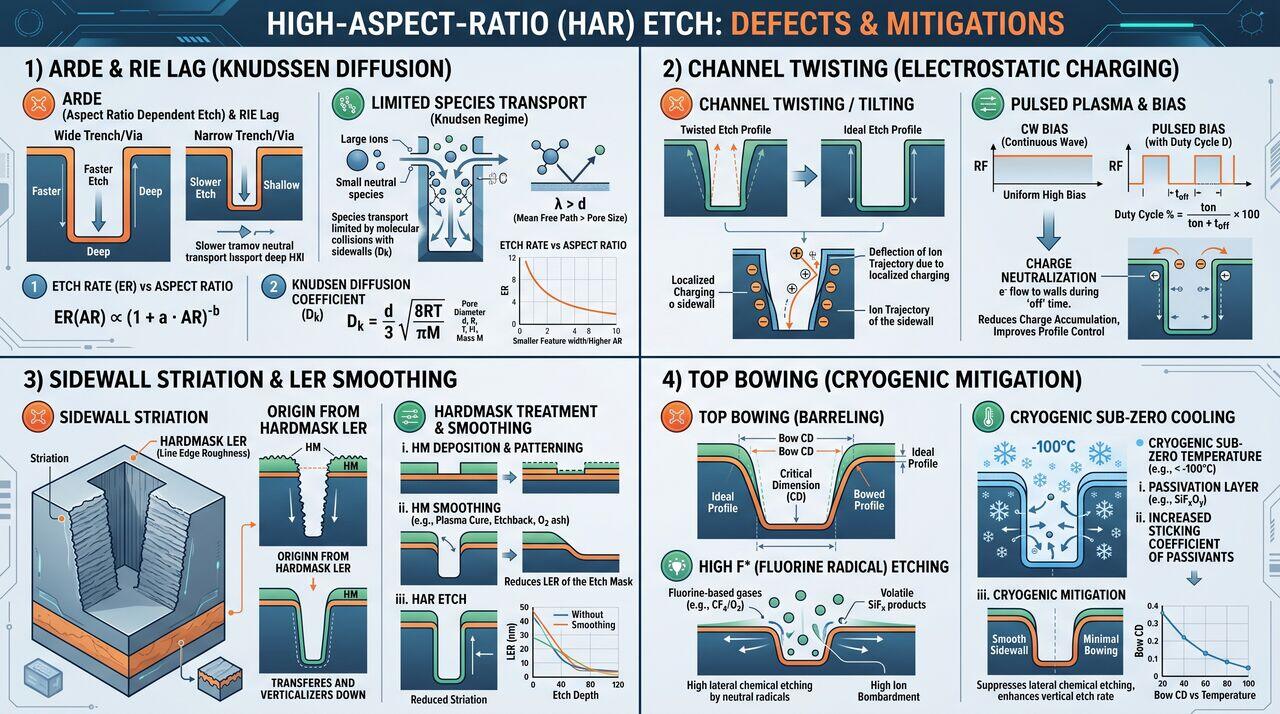
Aspect Ratio Dependent Etching (ARDE), historically termed RIE Lag, describes the phenomenon where the material removal rate drops monotonically as feature depth increases.
Knudsen Diffusion Flux Limit
Inside narrow high-aspect-ratio trenches (), the mean free path of gas molecules () far exceeds feature dimensions. Neutral radical transport transitions into the Knudsen Diffusion Regime, where Knudsen diffusivity () depends directly on feature radius (r) and thermal velocity ():
The neutral radical flux () reaching the trench floor at depth z follows the 1D steady-state diffusion-reaction equation:
Solving this boundary value problem reveals that neutral concentration at the bottom of an 80:1 trench drops exponentially, rendering chemical removal transport-limited.
02Ion Shadowing, Surface Charging & Channel Twisting Mechanics
In addition to neutral depletion, directional ions suffer from Ion Shadowing caused by the finite thermal angular spread of ions entering the sheath ().
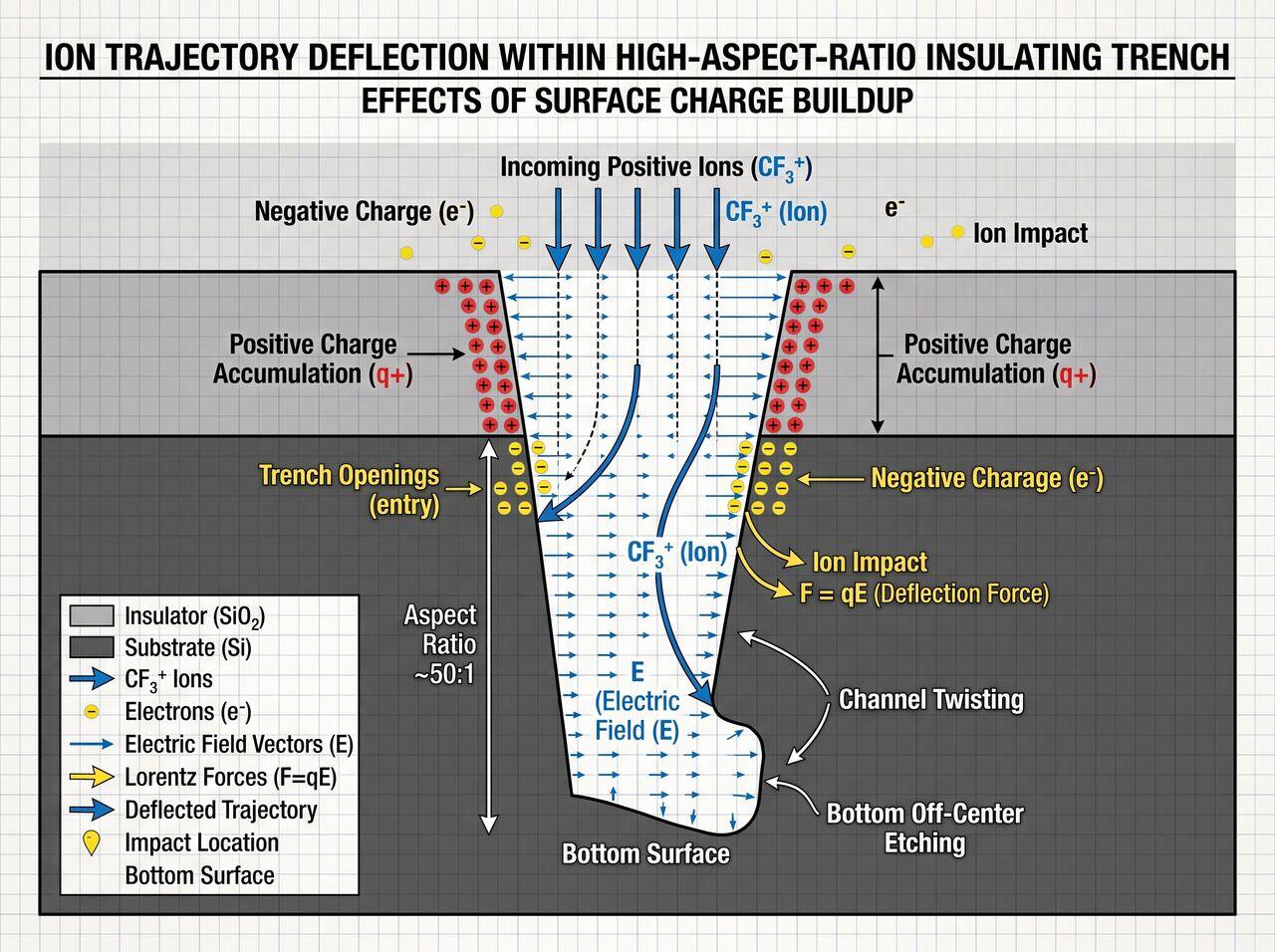
- Differential Charging: Due to higher thermal motion, isotropic electrons deposit preferentially near top trench corners, while directional positive ions penetrate deeper. This creates a net positive potential at the upper trench sidewalls.
- Trajectory Deflection: Incoming positive ions experience electrostatic repulsion from sidewall charge concentrations. Even a deflection angle causes ions to hit sidewalls prematurely rather than reaching the trench floor.
- Channel Twisting & Plugging: Stochastic variations in local mask edge roughness cause asymmetric charging, causing the ion beam to wander off-axis. As the trench deepens, the channel tilts or twists randomly, ultimately resulting in incomplete etching (channel plugging).
03Sidewall Striation & Micro-Roughness Propagation
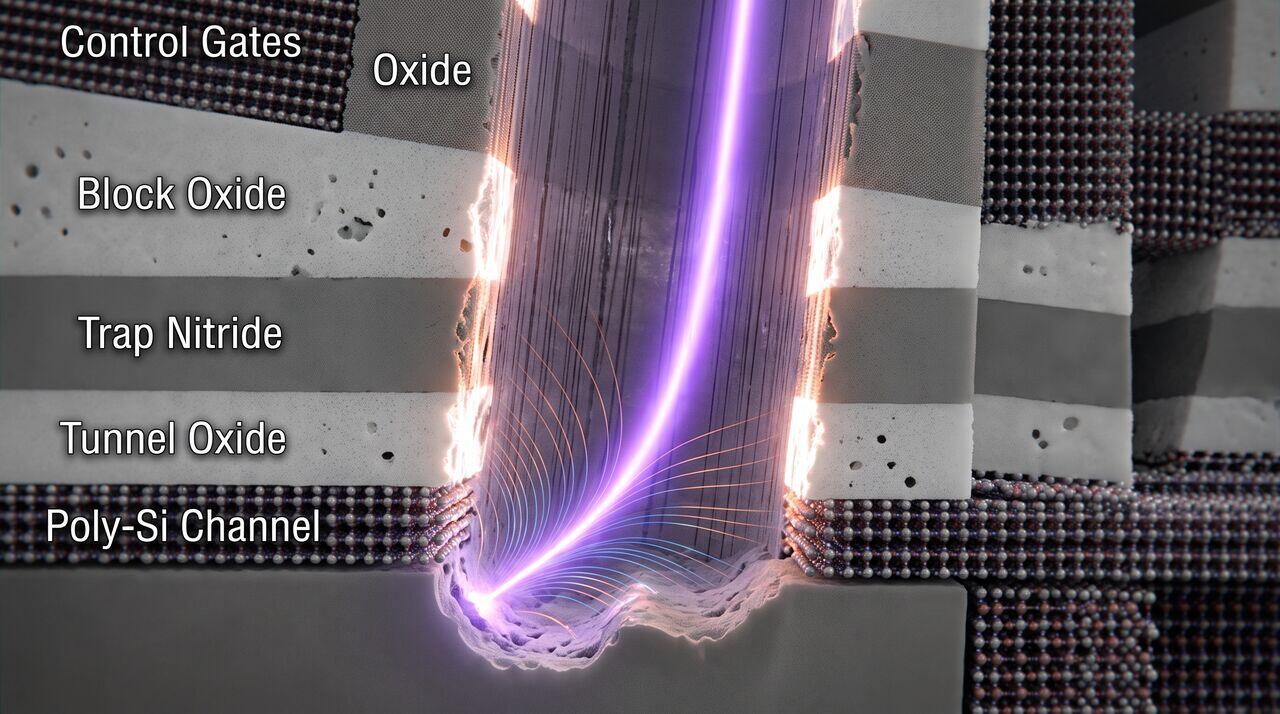
Striation refers to vertical streak-like defects formed along deep trench sidewalls that propagate down the entire length of a high-aspect-ratio feature.
- Origin: Line Edge Roughness (LER) in the overlying hardmask acts as a geometric scattering lens for grazing-incidence ions.
- Propagation Mechanics: High-voltage ions () strike mask edge asperities and scatter downward at shallow angles, carving microscopic vertical grooves into the underlying material.
- 3D NAND Penalty: In 3D NAND memory holes, sidewall striations cause localized gate oxide breakdown and threshold voltage () variations across memory cells.
→Prerequisites & continue reading
Prerequisites: ["p06-t6.3-t2-har-etcher-hardware-cryogenic-cooling-pulsed-power"]
Also in Topic 6.3, High-Aspect-Ratio Plasma Etching:
Tier 1 · High-Aspect-Ratio (HAR) Plasma Etching: Core Princip…Tier 2 · HAR Etcher Hardware: Cryogenic Sub-Zero Cooling & Hi…