01Introduction: The 11N Requirement
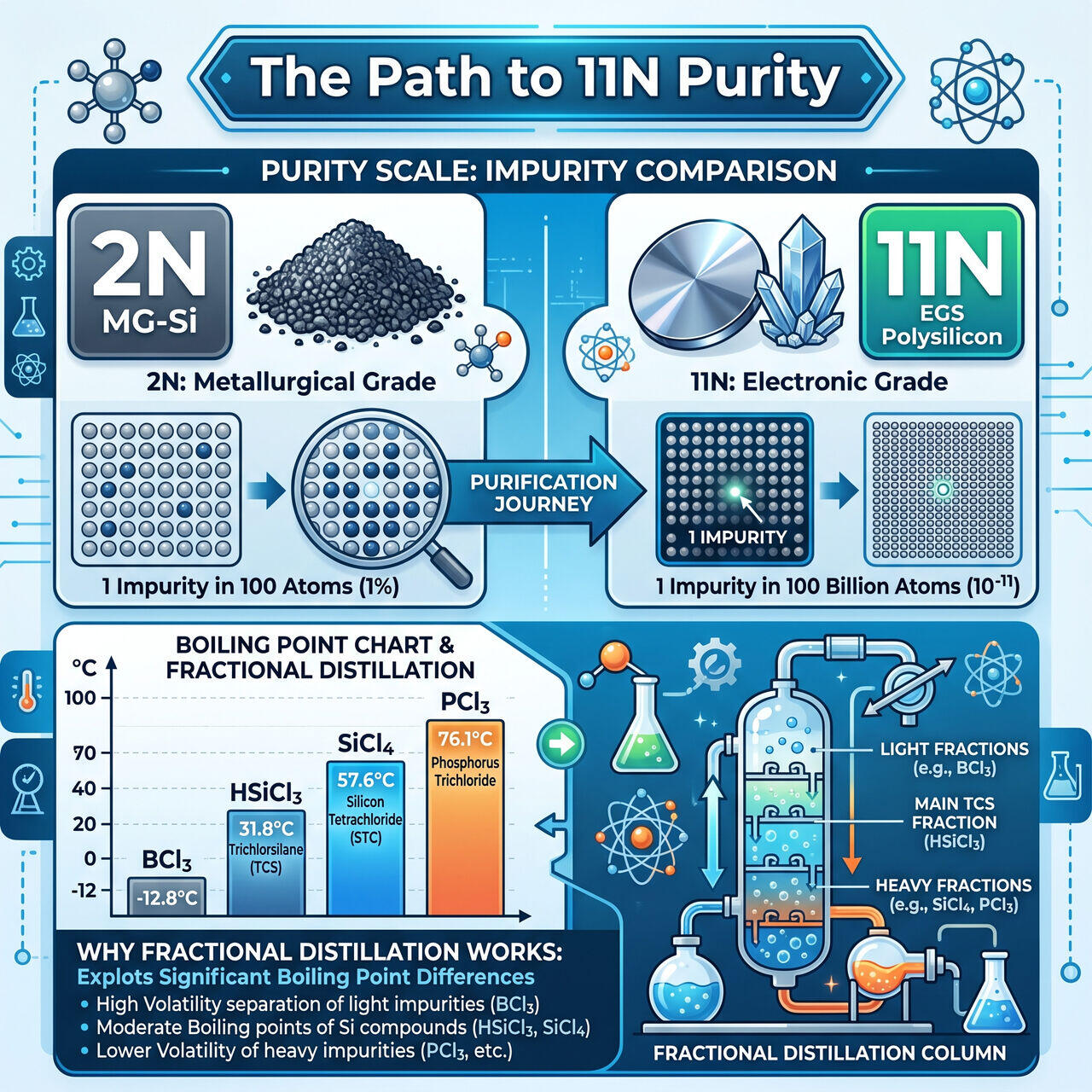
In the realm of semiconductor manufacturing, "pure" has an entirely different meaning than in traditional chemistry. While purity is considered exceptionally pure for commercial chemicals, an integrated circuit built on such material would fail instantly. At sub-2nm transistor nodes, a single metallic impurity atom per billion silicon atoms can cause gate oxide breakdown or severe current leakage.
Semiconductor-grade silicon requires a purity of 99.999999999%, universally referred to as 11N purity (eleven nines). This means that for every 100 billion silicon atoms, there is at most one non-silicon impurity atom.
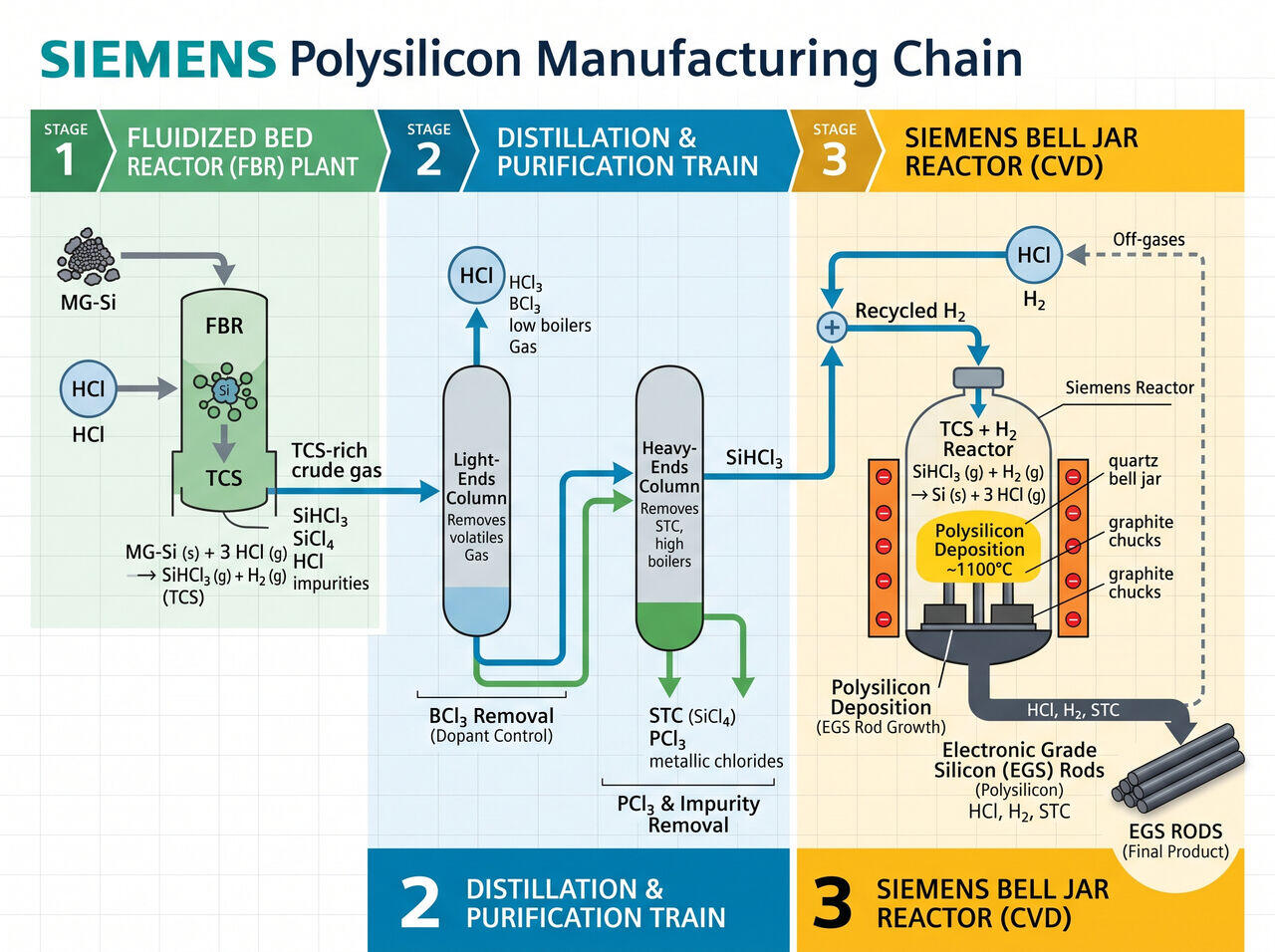
02Step 1: Synthesis of Volatile Trichlorosilane (TCS)
Solid Metallurgical-Grade Silicon () cannot be purified directly by thermal melting alone because metallic impurities like iron, titanium, and boron remain trapped in the liquid lattice. To separate silicon from its impurities, solid is converted into a volatile liquid compound called trichlorosilane (, or TCS).
Inside a Fluidized Bed Reactor (FBR) operating at , crushed powder reacts with anhydrous hydrogen chloride () gas:
Trichlorosilane is an ideal chemical vehicle because it has a relatively low boiling point of at atmospheric pressure, making it easy to vaporize, condense, and purify via fractional distillation.
03Step 2: Fractional Distillation
Once TCS is synthesized, it passes through a series of tall distillation columns. Fractional distillation exploits the differing boiling points of TCS and its impurity chlorides:
| Chemical Species | Formula | Boiling Point (°C) | Separation Difficulty |
|---|---|---|---|
| Boron Trichloride | Low boiling point; removed at top of column. | ||
| Trichlorosilane (Target) | Collected as pure middle fraction. | ||
| Silicon Tetrachloride | High boiling point; recycled to FBR. | ||
| Phosphorus Trichloride | Heavy fraction; removed at column bottom. | ||
| Metallic Chlorides | Non-volatile residue; easily isolated. |
By repeating distillation through multiple columns in series, impurity concentrations are suppressed below parts-per-trillion () levels.
04Step 3: Siemens Chemical Vapor Deposition (CVD)
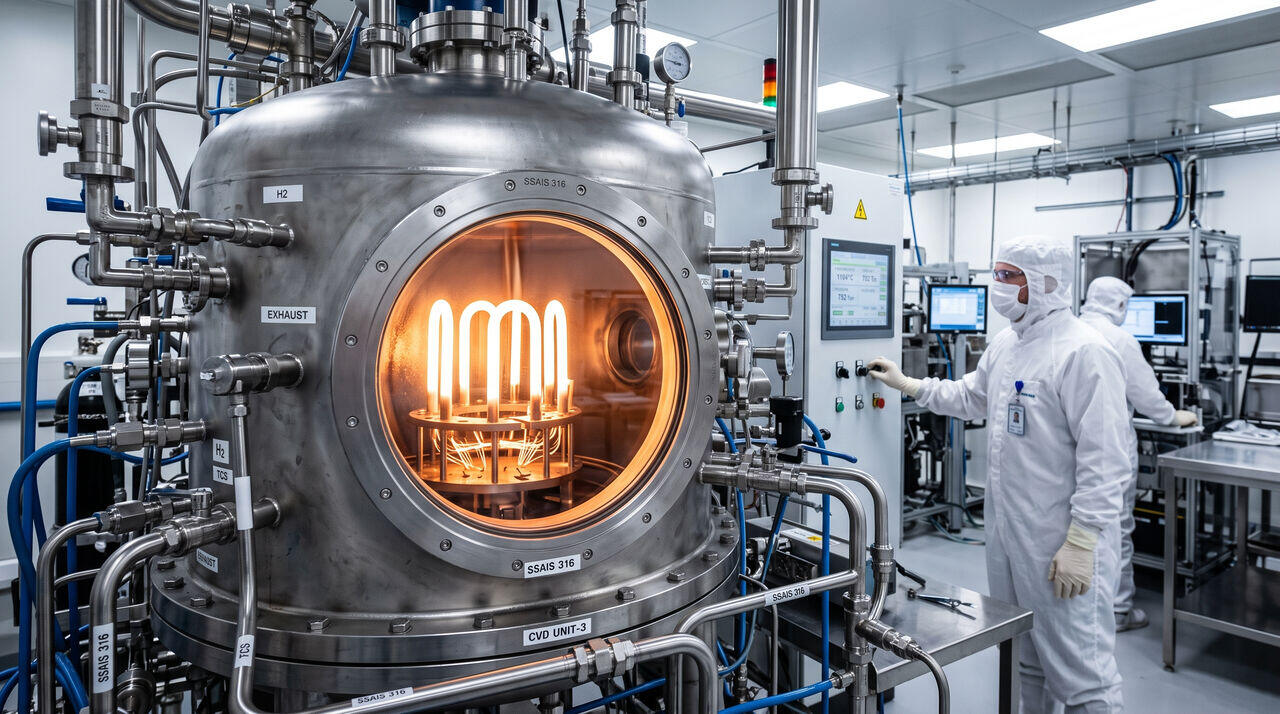
The ultra-pure TCS liquid is vaporized, mixed with high-purity hydrogen gas (), and injected into a sealed Siemens CVD Reactor. Inside the reactor, slim filament rods of pure silicon are electrically heated to .
When the gas mixture contacts the red-hot silicon filaments, TCS undergoes chemical reduction, depositing pure elemental silicon onto the filaments:
Over several days, the slim filaments grow into thick, dense rods of high-purity Electronic-Grade Polysilicon (EGS) measuring up to in diameter and in length.
05Key Takeaways & Summary
- 11N Standard: Semiconductor fabrication demands pure silicon to prevent microelectronic defects.
- Volatile Vehicle: MG-Si is reacted with gas to form trichlorosilane (), a volatile liquid with a boiling point of .
- Distillation: Fractional distillation separates TCS from metal chlorides () and dopants ().
- Siemens CVD: Purified TCS gas decomposes on heated silicon filaments at to yield ultra-pure EGS polysilicon rods.
→Prerequisites & continue reading
Prerequisites: Understanding of MG-Si production (Topic 1.1) and basic chemical distillation
Also in Topic 1.2, Chemical Purification & the Siemens Process:
Tier 2 · Fractional Distillation Columns and Siemens CVD Reac…Tier 3 · CVD Deposition Kinetics and Mass-Transfer Dynamics i…