01Introduction: The Wet Processing Workhorse
Wet processing accounts for nearly of all process steps in a modern semiconductor manufacturing facility (fab). Every wafer undergoes dozens of wet cleaning, etching, and surface preparation steps between lithography, ion implantation, CMP, and film deposition.
Fabs rely on two primary types of wet processing equipment:
- Automated Batch Immersion Wet Benches: Processing multiple wafers simultaneously in liquid tanks.
- Single-Wafer Spin Processing Tools: Processing individual wafers on spinning chucks.
02Automated Batch Immersion Wet Benches
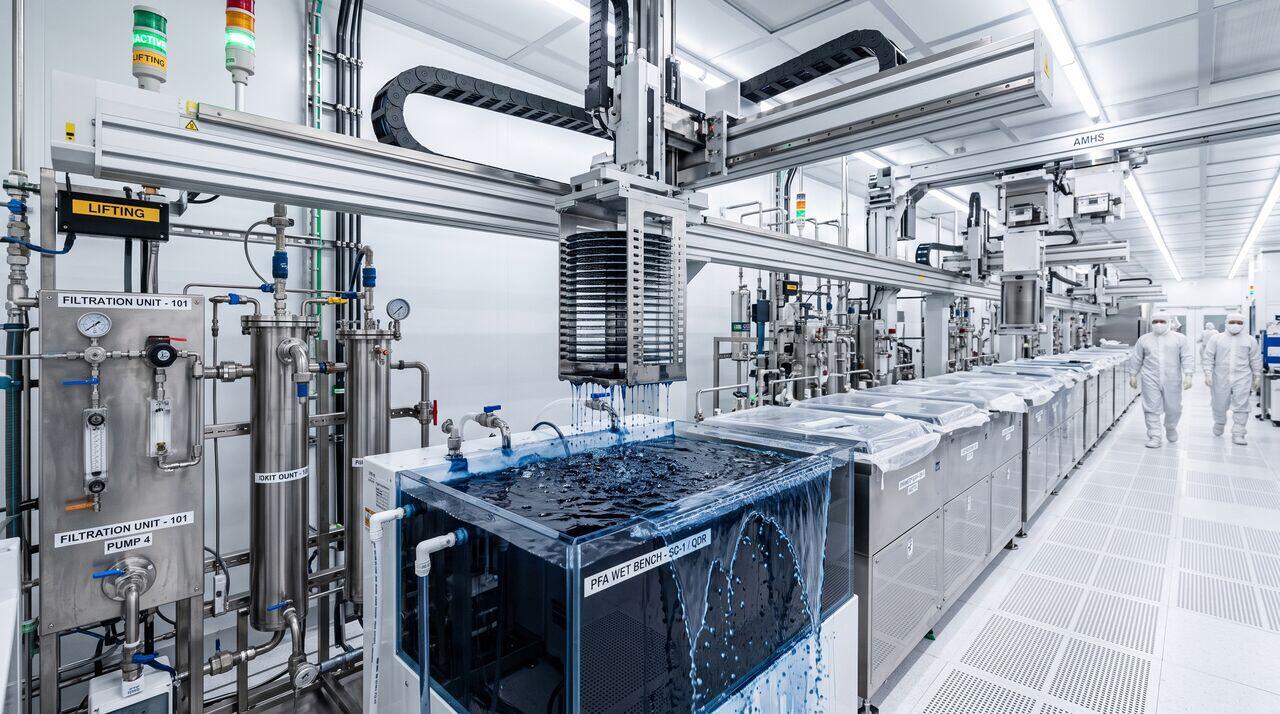
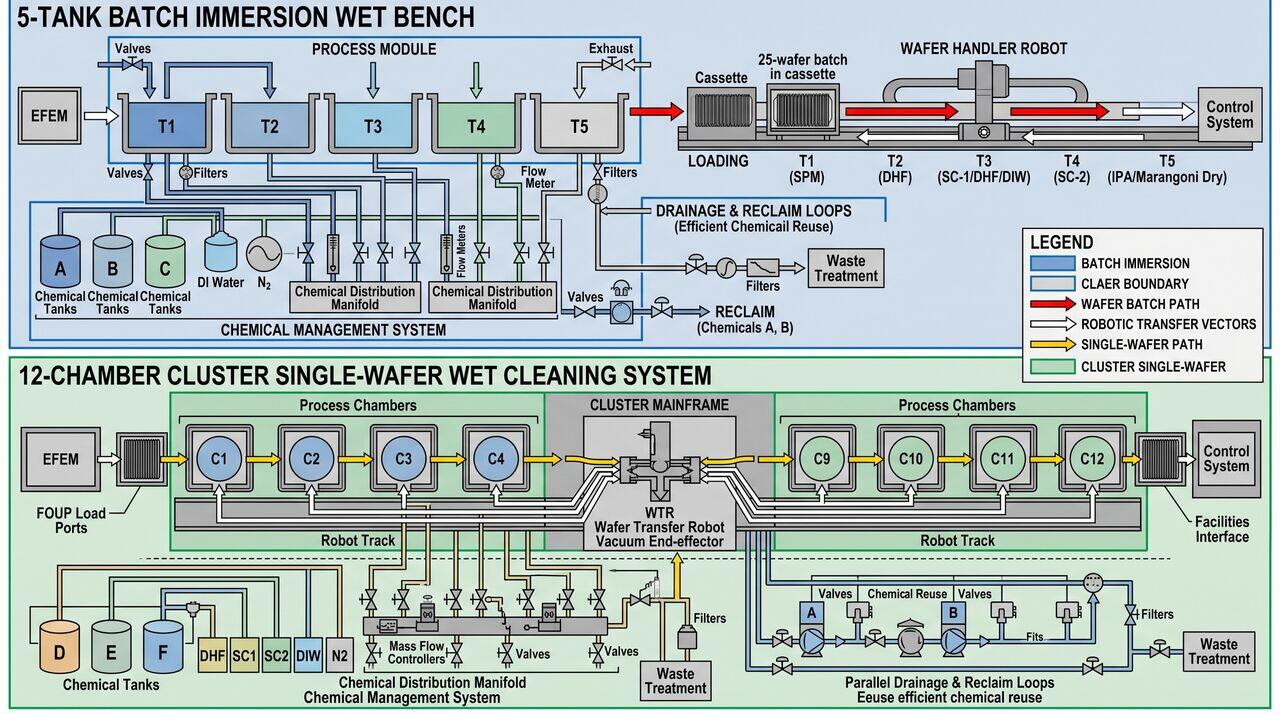
In a wet bench, 25 to 50 wafers are loaded into a quartz or plastic carrier (cassette) and sequentially dipped into a series of chemical tanks and rinse baths by a high-precision robotic robot arm.
Key Workflow Steps
- Chemical Bath Immersion: Wafers sit in recirculating chemical baths for 5 to 10 minutes.
- Quick Dump Rinse (QDR): Wafers are transferred to a rinse tank where deionized water (DIW) rapidly fills and dumps to strip chemicals.
- Drying: Wafers move to a Marangoni or isopropyl alcohol (IPA) vapor dryer to emerge completely dry and spot-free.
03Single-Wafer Wet Cleaning Tools
Single-wafer wet tools process wafers one at a time inside sealed processing chambers. The wafer is mounted on a mechanical or bernoulli spin chuck that rotates at speeds between 500 and 2000 RPM.
Key Operational Features
- Multi-Axis Chemical Arms: Precise robotic arms dispense fresh chemicals directly onto the center of the spinning wafer.
- Chemical Reclaim & Splashboard Switching: Movable splash rings shift up and down to collect spent chemicals into separate drain channels for recycling or disposal.
- Integrated Nitrogen Drying: High-speed rotation combined with heated gas dries the wafer in seconds.
04Fundamental Choice: Volume vs. Precision
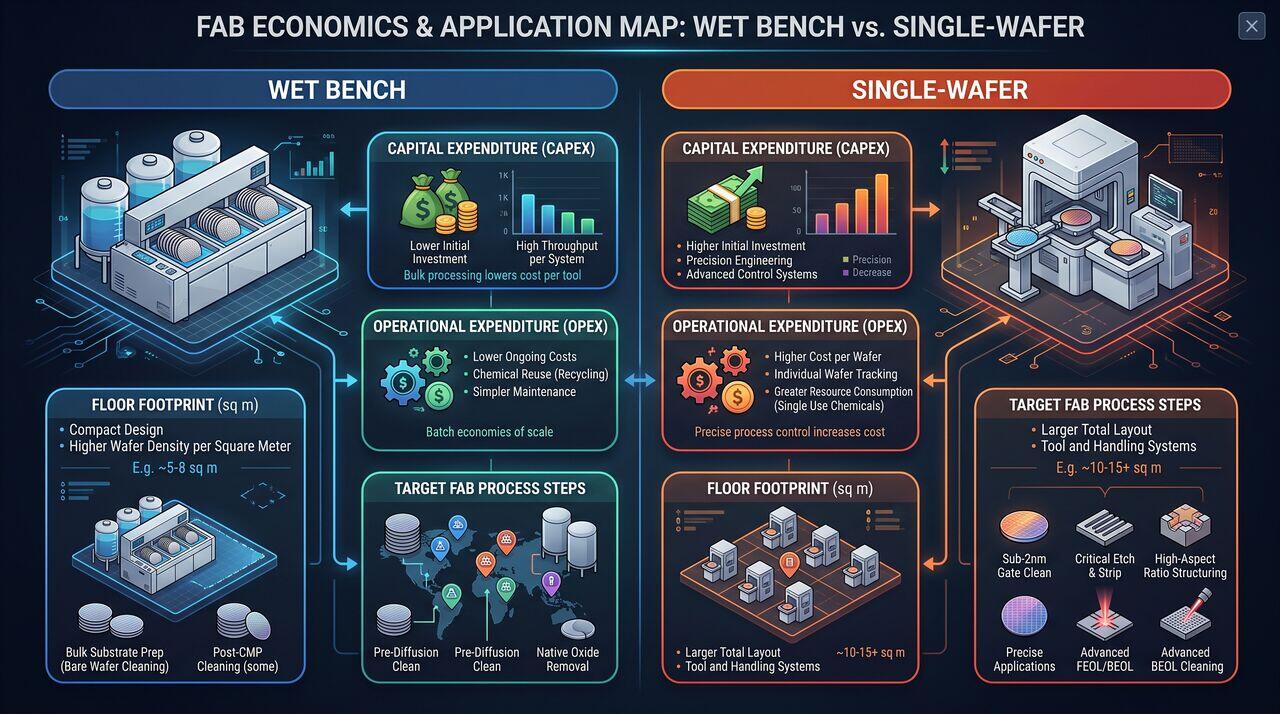
| Operational Metric | Batch Immersion Bench | Single-Wafer Tool |
|---|---|---|
| Production Speed | Very High (250+ wafers/hour) | Moderate per chamber (requires stacked frame) |
| Chemical Consumption | Low per wafer (recirculated baths) | Higher per wafer (point-of-use chemicals) |
| Flexibility | Fixed recipe sequence per bench | Instant recipe switching per wafer |
| Wafer-to-Wafer Uniformity | Minor edge-to-center variation | Superior radial uniformity |
→Prerequisites & continue reading
Prerequisites: Basic Semiconductor Manufacturing Knowledge
Also in Topic 4.2, Wet Bench vs Single-Wafer Processing:
Tier 2 · Fluid Dynamics & Chemical Recirculation Hardware Arc…Tier 3 · Boundary Layer Mechanics, Mass Transfer & Cross-Cont…